2107 UTC | 30°37.084’N 031°58.980’W
Sailing
Dearest mother,
I hope this my second letter finds you well. Many days have passed since I last wrote you, and several interesting things have taken place which I intend to tell you about.
First - our battle against the diesel algae continues. Through hard work, determination, and some wit, it seems we are holding them off. Like I mentioned, their stronghold by all means seems to be in the diesel intake manifold - a cunning move on their part, as we have no way to reach into all the nooks and crannies of this contraption, despite all of the tools at our disposal. Luckily, our Skipper’s wit is as great as ever, and in a move of pure genius that would have impressed even Lord Nelson himself he decided that we simply take the fuel line from the tank off the manifold and lead it directly to the magnetic filter, leaving our foes completely out of the game. Thus, our main as well as our generator remain up and running.
A recent topic of discussion on board as of recently has been the different units of measurement available to our species. This seems to be causing some confusion on board; most recently some days ago when the Skipper and First mate got into a spat. You see, mother, our friends across the pond, of which our First mate is one, would not say that a stick is one meter long. Instead, they would say that it is something like three feet, and would you want more specific measurements, you must be sure to remember that each foot is divided into not ten, but twelve inches. If you want to speak with them about the weight of something, you would ask how many pounds there are, but in this case remember that each pound is made up of sixteen ounces - and so it goes on.
The discussion the other day, though, was about temperature. First mate Delaney readily agrees that their order of measuring length and weight can seem somewhat confusing, but was adamant that Fahrenheit is far superior to Celsius when it comes to measuring temperature. In America, you see, water does not boil at a hundred degrees Celsius, but rather at two-hundred-and-twelve Fahrenheit. It freezes not at zero, but thirty-two degrees. The Skipper was hard-pressed to find any logic to this, and I must say I readily agree with him. After some discussion, it was decided that since Adrienne flies the Swedish flag on her stern, we shall use Celsius on board, and hope our mate does not forget and sets the freezer to ten degrees...
Our journey is now well over half way, and since a few days we are headed due east, pointing our beloved Adrienne right at the Canaries for the very first time. Skipper Erik is a wizard with the barometer, each night sharing his predictions for what the weather has to bring, be it high pressure ridges, squalls, and fronts cold and warm. Thanks to his precision, we have avoided heavy weather and enjoyed fair winds so far on our journey.
Nine hundred miles remain between us and our destination.
I promise to write you again soon.
Yours truly,
Apprentice Anton
View more passage logs
The Wheel Keeps on Turning
Helming is basically steering the boat by hand. Helming is so completely unlike driving anything else. How each of us put all this information and sensation together to guide our hands and keep Adrienne going where we want to go - to stay the course as the saying goes - is as different as the individuals on this boat. Well there you have it helming as described by six people who approach the same basic task with highly varied perceptions, feelings, and even emotions.

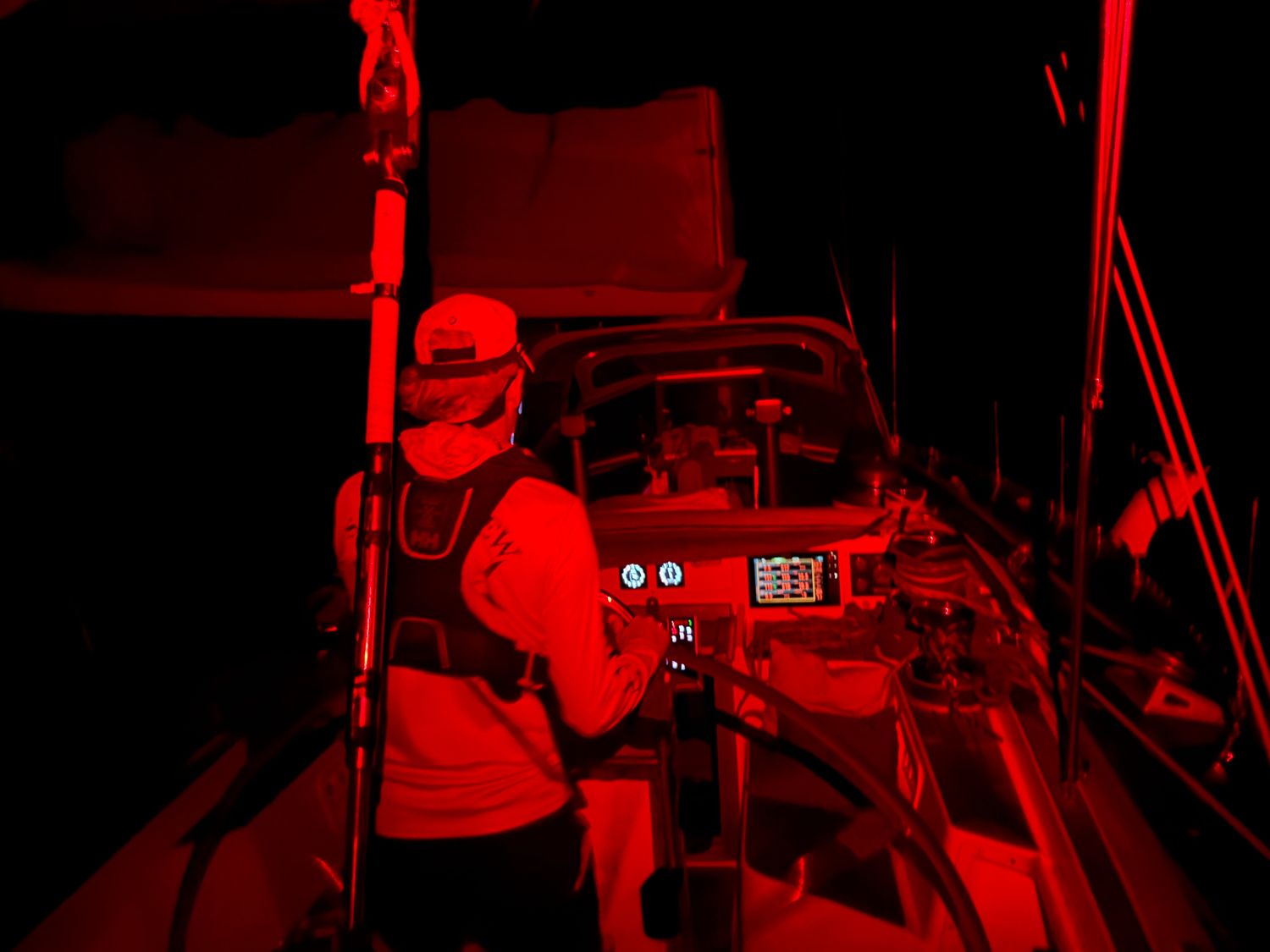
Navigating with the stars
Once the bimini was folded up the view across the starlit dome above our heads had us in awe and got our full attention. I am writing this during the same watch as I aim to share the beauty of the ocean and special moments we are witnessing during our voyage. Tonight, that light (coming from within and outside our galaxy) is guiding us across this vast open space towards our destination. Witnessing and sharing constellations builds a link to ancient cultures and seafarers, and this view into a world of lightyears and galaxies challenges the day to day notions of space and time you so recently left behind. Thank you for joining us as we sail under the stars.
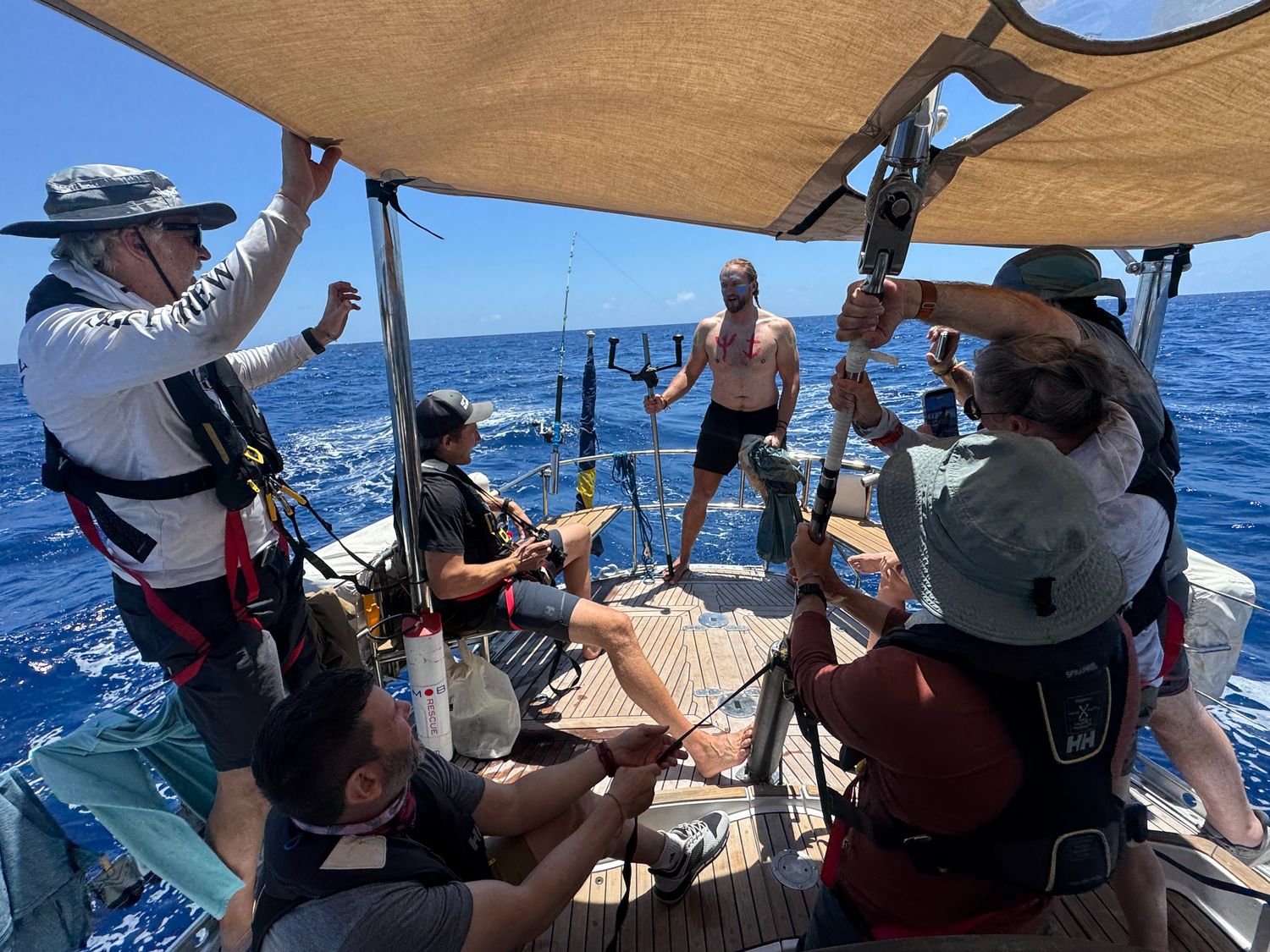
Equator Day!
Excitement was in the air as the day dawned, the Equator grew ever closer. Those who go to sea often hear of King Neptune arriving at such a time in order to promote those worthy souls from Pollywog to Shellback, in the watery realm. We were still surprised when he arrived and called upon us to honour tradition and answer for crossing the equator without permission. For me this was one of the features of the trip and it did not disappoint. This is definitely a passage to remember.