0129UT | 49 43.96’N 127 58.40’W
Sailing
Ahoy Shipmates!
Day three out of Ketchikan and FALKEN is running wing on wing down the outside of Vancouver Island.
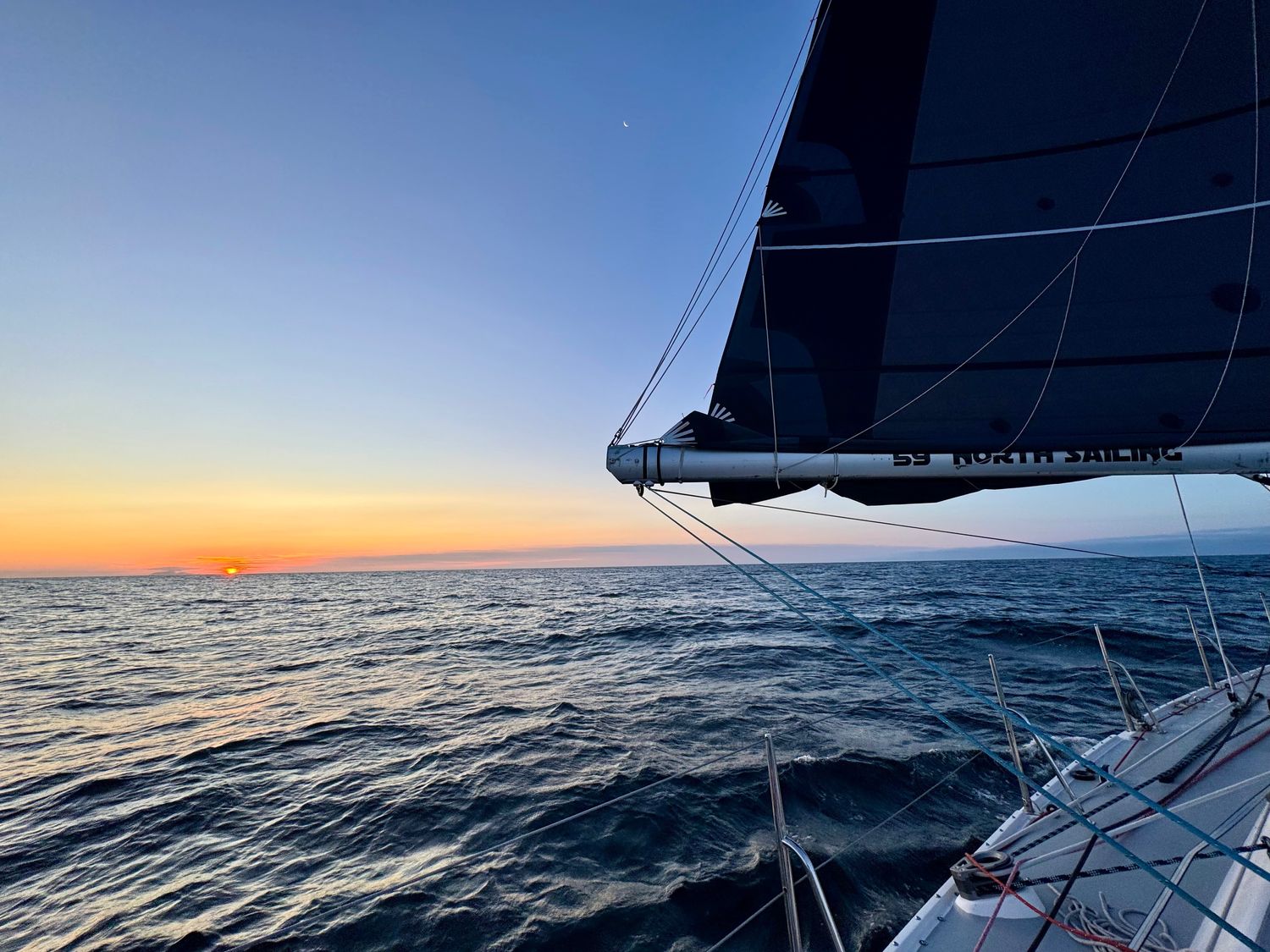
As the sun sets in a cascade of fire and Venus appears low in the sky to starboard, the magic of a clear night at sea settles over us. The wind fills in as we round Cape St. James into the open ocean.
With not a cloud in the sky and the sliver of a moon not yet up, the stars dominate, every constellation sharp above us. The only sound is the following waves carrying us along as we wander south.
The temptation is to lie back in the cockpit and spend the night watching for shooting stars, but a diligent watch is always the first priority. We are in prime fishing boat territory, and not all of them are marked on AIS. So we keep a sharp eye out while the shooting stars keep us company through the night.
After a good sleep I draw the lucky watch that catches the sunrise. The wind has clocked round, and we work to set the pole sailing wing on wing, making a steady 8knts. The day is clear, with visibility all along the coast of Vancouver Island. The wildlife keeps coming: humpback and minke whales, five mola molas, dolphins, and a black-footed albatross.
And one round log. I swear it looked just like a turtle.
As the smells waft out of the galley and the crew gathers for dinner. We are all feeling lucky for such conditions!
Hold Fast, Virginia
P.S. Duncan says, “Hi, Nana!”
Fun fact of the day! Nautical miles are different from land miles because…
Land miles: Rooted in ancient Roman history, a statute mile originally came from 1,000 double-steps (paces) of a Roman soldier. It was later set at a flat 5,280 feet.
Nautical miles: Developed for marine and celestial navigation, a nautical mile is mathematically tied to the Earth’s circumference. It represents 1/60th of a degree (one minute) of latitude — about 1.15 statute miles, or 1,852 metres.
Virginia Marcy
View more passage logs
Day Four: The boat has figured us out
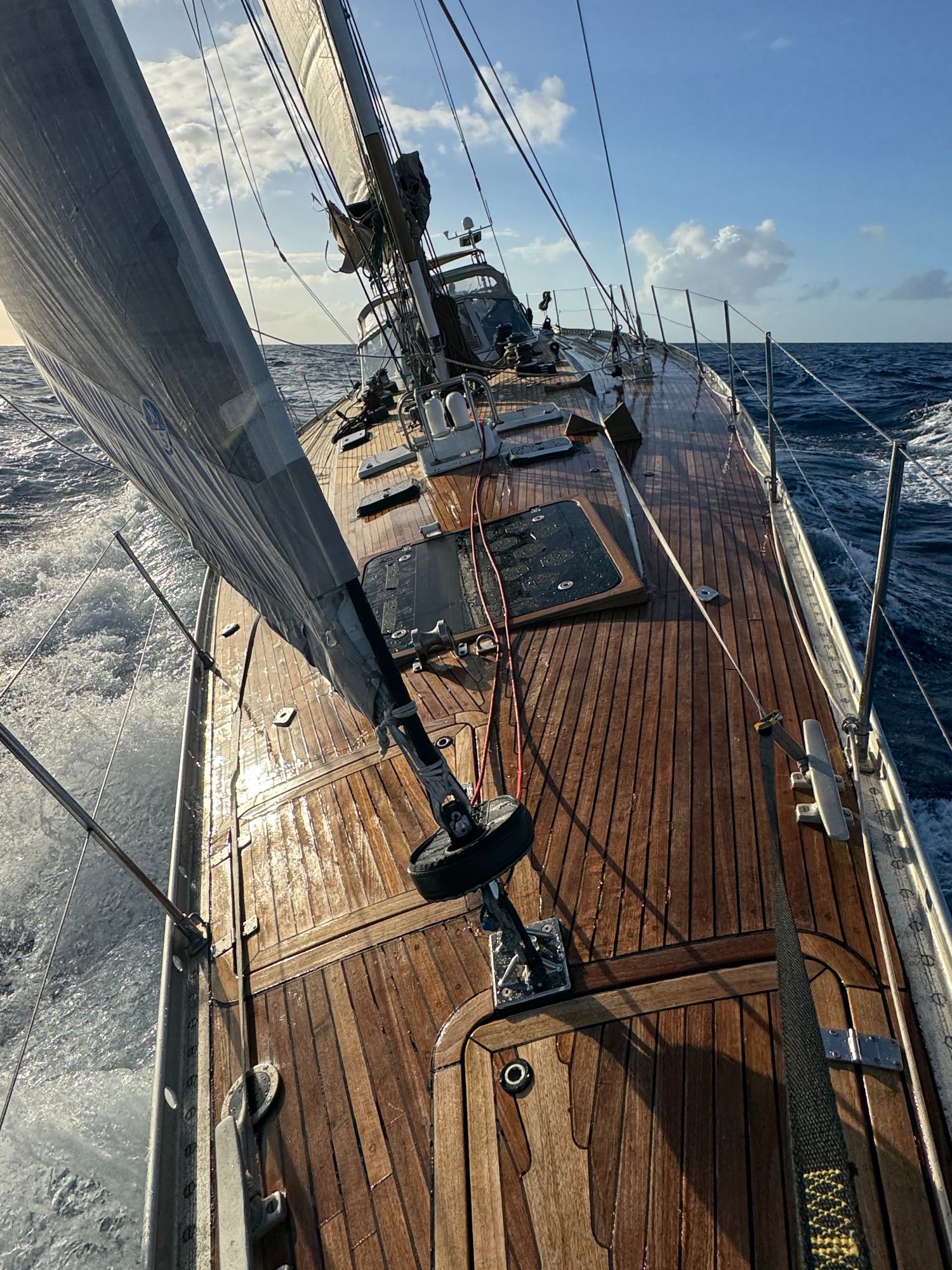
By day 4, things start to get into a rhythm that starts to look like a small community onboard. It’s when personalities start to flourish, when people start losing themselves and start to realize that they don’t really care about a lot of things! I’m pretty sure the disconnection from the internet starts aligning our inner selves. Clearly everyone has gotten their sea legs by now, and even the boat seems to have understood the type of crew she has now. I love to see how people start fitting into different roles with their peers and the boat itself.

Kärt barn har många namn
A dear child goes by many a name, or as we say in Swedish "kärt barn har många namn". This is the case for many a person, but also some species, not least the Mahi mahi, which also goes by dolphin fish, golden mackerel, and dorado, among others. Soon, we could see the fish jump, a hundred feet or so behind the boat, and as I kept reeling, a beautiful Mahi appeared under the surface. Manot showed us how to clean and fillet it, and after a complete team effort two large fillets are now in the freezer of Adrienne II.
Cast off the lines
When we awoke it was overcast but the Brazilian sun quickly burned the clouds away and we were left with blue skies. We reviewed some safety procedures, cleaned the boat and had an exciting Person Overboard (POB) recovery. Once we were underway spirits soared as we pointed the bow toward the Canary Islands. As I write this we are heading upwind and dealing with all that involves, and working into our first watches. It is hot, a bit bumpy but we are sailing!!