Somewhere over the Norwegian Sea
Somewhere over the Norwegian Sea
Quarterdeck source: https://quarterdeck.59-north.com/posts/falken-leg-10-2023-newfoundland-%E2%86%92-greenland-%E2%86%92-iceland
Import identity: quarterdeck:40062996:section:01
Original heading: Day not sure, August 19 // Somewhere over the Norwegian Sea
Import batch: Greenland 2026-11-27. Passage matched by boat, year, leg and route; author matched to the voyage roster. Original source HTML preserved locally.
DATE ADJUSTMENT requested by Andy on 2026-11-27: logbook_date is 2023-08-15, the passage end date, so the retrospective appears at the end of the map track. Original written date is 2023-08-19, aboard the flight home over the Norwegian Sea; original heading and prose preserved. Author attribution supported by first-person references to Mia, Axel and skippering this voyage. Shared page lead image retained for this final retrospective.
Day not sure, August 19 // Somewhere over the Norwegian Sea
I’m on my way back home to Sweden. This will be the first time that Mia, me and Axel will all be home, at our own house, as a family since early April when Mia left for FALKEN’s Trade Wind trans-Atlantic. After joining FALKEN in Annapolis and skippering the return trans-Atlantic to Iceland, I’m about to come home and complete the loop.
I’m struck by how quickly the scenery changes after these long ocean voyages. One minute you’re in the middle of the high seas, the next you’re dockside drinking champagne and eating cheese at two o’clock in the morning. And the next you’re on an airplane high above the same ocean you just traversed, covering the same ground that took you days and weeks of hard work and hardship in just a couple of hours.
My friend Tom put it best — offshore, the minutes and hours go by oh-so-slowly, yet somehow the days go by in a flash.
—
We spent two nights more than I’d initially anticipated in Greenland waiting for the weather offshore to turn. I almost wrote two nights more than I’d “planned”, but that’s not really accurate, cause I knew better than to firmly plan anything in that part of the world. What I did plan was time to wait. There was no rush.
After towing our newfound friends John, Sophie and their yellow lab Nine in their Contessa 32 to the weather station at the east end of Prins Christian Sund, we switched from ‘explorer’ mode into ‘weather window’ mode, a fine balancing act of prepping the boat for the next leg, conserving energy for the upcoming watch rotation, and still staying in the moment and experiencing the last few hours of Greenland. This conflict — that of energy conservation versus making the most of our fleeting time — was never more apparent than in that moment when my mind hit on the idea of swimming with a big growler that was near the boat. Matt saw this happen in real time — me looking over at the ice, the lightbulb going off inside my head, the facial expression that clearly said ‘I don’t really have the energy to do this right now, but I know I can’t help myself, so wtf, let’s do it.’
(It was worth it.)
—
We had our only real ‘sea story’ of the entire summer when on departure, as we’re motoring out of the fjord with the mainsail set at one reef, James came out from the cabin and asked if I had noticed that half the electrical panel at the nav station was blacked out.
“Um, no.”
I rushed below to find the 24V house panel was completely blank — the switches were still on, but there were no lights. No refrigeration. No heat. No propane solenoid. And on. It was 0430 and we were heading out into a pronounced swell on what was looking to be an upwind-all-the-way passage to Iceland.
As a brief aside, I hadn’t noticed this in the cockpit because none of my navigation equipment went out. All the instruments were functioning, nav lights were on, the radar was still picking up targets from the icebergs offshore. This was by design — FALKEN has a robust Lithionics lithium battery system installed with several redundancies should the lithium system, inherently more fragile than lead-acid, black out. While all the house loads run from the 24V lithium system, the ‘mission critical’ navigation electronics and the engine start batteries are AGM lead-acid, running on a totally separate grid and isolated from the house lithium bank. More on this is written on the Quarterdeck, but suffice it to say this is the first time where these built-in redundancies really proved their worth. The system worked as designed.
I began troubleshooting while James and crew piloted FALKEN back into the shelter of the bay we’d been anchored in. Vilma had been asleep — we’d gotten into a good early-morning-departure routine whereby I’d wake up at 0345 and get the ship sailing with the crew while Vilma rested. Then she’d relive me at 0800 and we’d settle into our watch rotation. She’d been asleep, past tense, but with all the commotion she was now awake. Not to mention the diesel exhaust now permeating the aft cabins where the staff sleep. The diesel heaters run on the 24V lithium bank, and they got shut off too. When they’re not able to go through their shut-down procedure, the unburned diesel in the system gasses off and creates a stinking haze. Not a good way to prevent seasickness.
To make a long story less long, what had actually happened is that a 200-amp fuse blew at the load bus on the lithium system due to an earlier chain jam in the windlass that overloaded the system. There is indeed a breaker on the windlass that is meant to pop on just such occasions, but for some as-yet-undiscovered reason, that breaker is sized larger than the load bus fuse (this should definitely not be the case, and is a fault of the initial installation. The question remains, is the load bus fuse too small, or is the windlass breaker too large? To be continued…) In any case, a couple quick checks with the multimeter and I quickly found the popped fuse, replaced it with a spare and we were back in business.
(As I type this last sentence the outer reaches of the west coast of Norway just appeared out my plane window. We’re over the approaches to Bergen now — somewhere 30,000-ft below us is ISBJØRN, tied up safely after her recent passage south from Bodø, and not far away her skipper August and his family on their island at Hjelmås. If I had binoculars I might be able to pick it out from here. Some of the interior mountains have snow on the tops).
False start aside, we got offshore as the sun was rising and settled into the watch routine in a rough leftover sea and no wind. I don’t mind motoring at the start of a passage, in fact almost prefer it, to give everyone a chance to get their sea legs before the hard work of sailing begins. The ice which we never saw on the approach to Greenland in the fog, m was stacked up on the shorelines and the largest barge we’d seen yet were visible over the horizon. As the weather had been for the duration of our stay in Greenland, skies were crystal clear and you could see forever. The wind filled in after a few hours and soon FALKEN was sailing close-hauled under full sail on a lumpy sea. Greenland’s mountains and glaciers stretched out to the horizon behind us and remained quite clearly visible even as we sailed beyond 50-miles from the coast. Quite the site, and something we were robbed of on our landfall when we saw nothing until we were literally in the harbor at Nanortalik.
The wind continued to build through the second day at sea, as we knew it would. We’d waited back in the fjord because a giant, strong low-pressure system had parked itself to the southeast of Iceland, pounding the west coast of Ireland and the English Channel with gale force southwinds and seas. Meanwhile, in the low’s NW quadrant, the wind was funneling in the Denmark Strait between Iceland and Greenland, blowing hard from the NE for days and kicking up that large swell that we felt some 700 miles away. As we said NE, this band of wind would slowly ease off, but we’d have headwinds for the majority of the passage regardless.
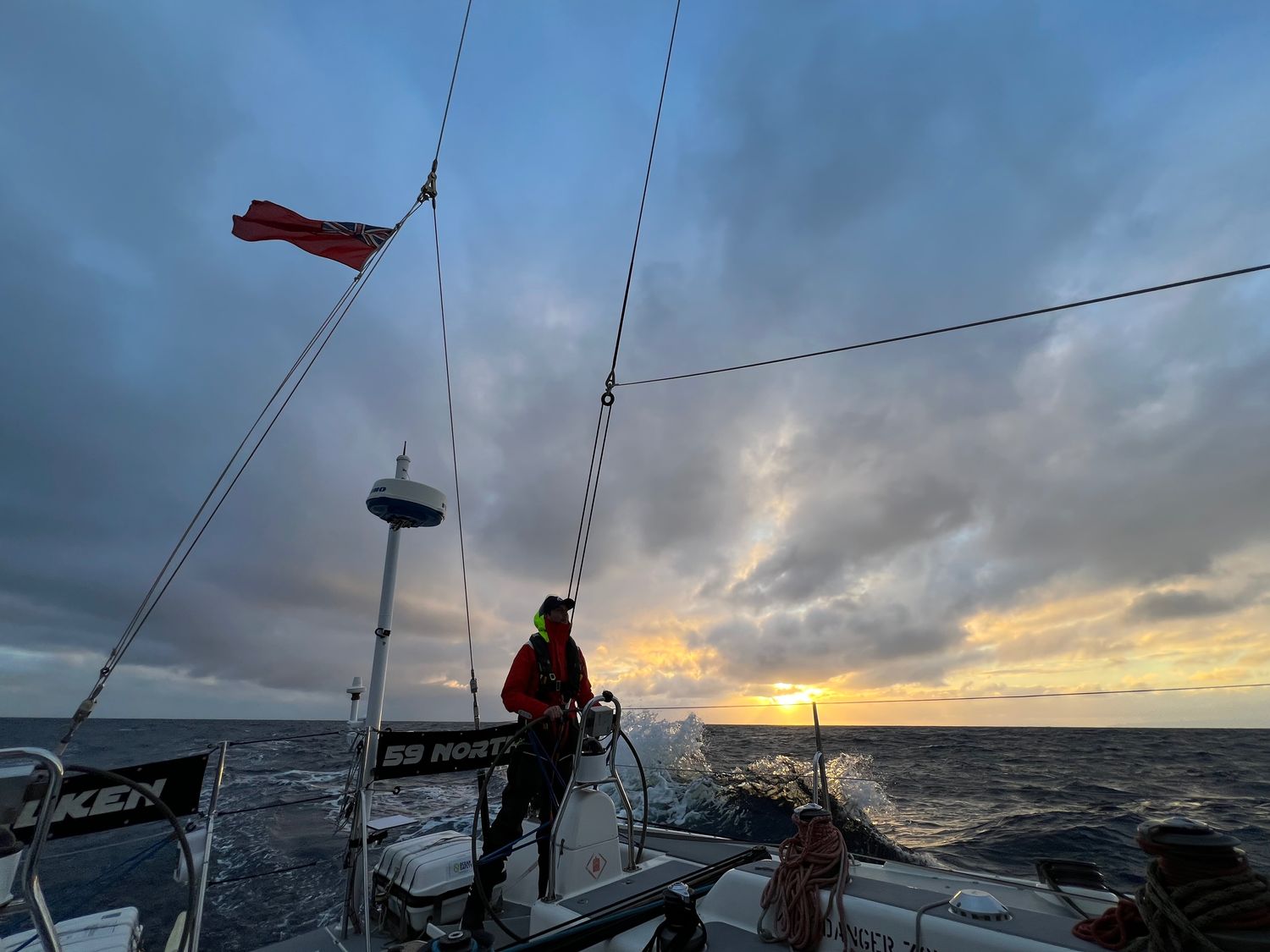
By dinnertime on that second night we were down to two reefs in the mainsail and just the staysail up front, sailing fast and on course but in a horrendous sea. The wind never got above 30 knots true, but the waves, which had been building all the days prior in the 45+ knots of wind were wild. Big and steep, flat walls that kicked the bow skyward and then opened up a hole in the ocean behind them which FALKEN would disappear into with a thundering crash. Sleeping the aft part of the boat was impossible — the crew in the fo’c’s’le had to hang on just to remain in their bunks, going weightless for a moment when the bow came crashing down. These were by no means the biggest seas I’d seen, maybe only 8-10 feet, but on that close-hauled point of sail, there were definitely the meanest.
We opted to hove-to for the night and let the weather work itself out. It wasn’t so much a choice as a necessity. It was impossible to proceed upwind in those sea conditions. The risk of breaking the boat or breaking the people was too much. Had we been sailing downwind, or even across the wind, we’d have had a completely different strategy, likely, a fast sail. Heaving-to allowed us to hold position and wait for better conditions (I do believe we were also in some kind of current eddy to create waves like that. My suspicion was strengthened by how quickly the seas subsided the next day).
FALKEN sat hove-to for 18 hours this time, longer than on our first leg, and out of necessity rather than strategy this time around. By breakfast next morning though we were under way, across the band of strongest NE’lies and riding a now dying breeze, which two days later would be gone altogether.
Land appeared on the horizon early next morning. By then the wind was a light zephyr from the north, FALKEN back to full sail and gliding peacefully across a calm sea. While not exactly on course, port tack was still favored and we sailed as long as we could hold onto the breeze, which was many hours longer than we and the GRIBs had predicted. It only died completely as we approached the corner of the Westfjords and we began motoring up the deserted, enormous 60-mile coastline in the sunshine, taking our first showers in four days and drying out in the warm air.
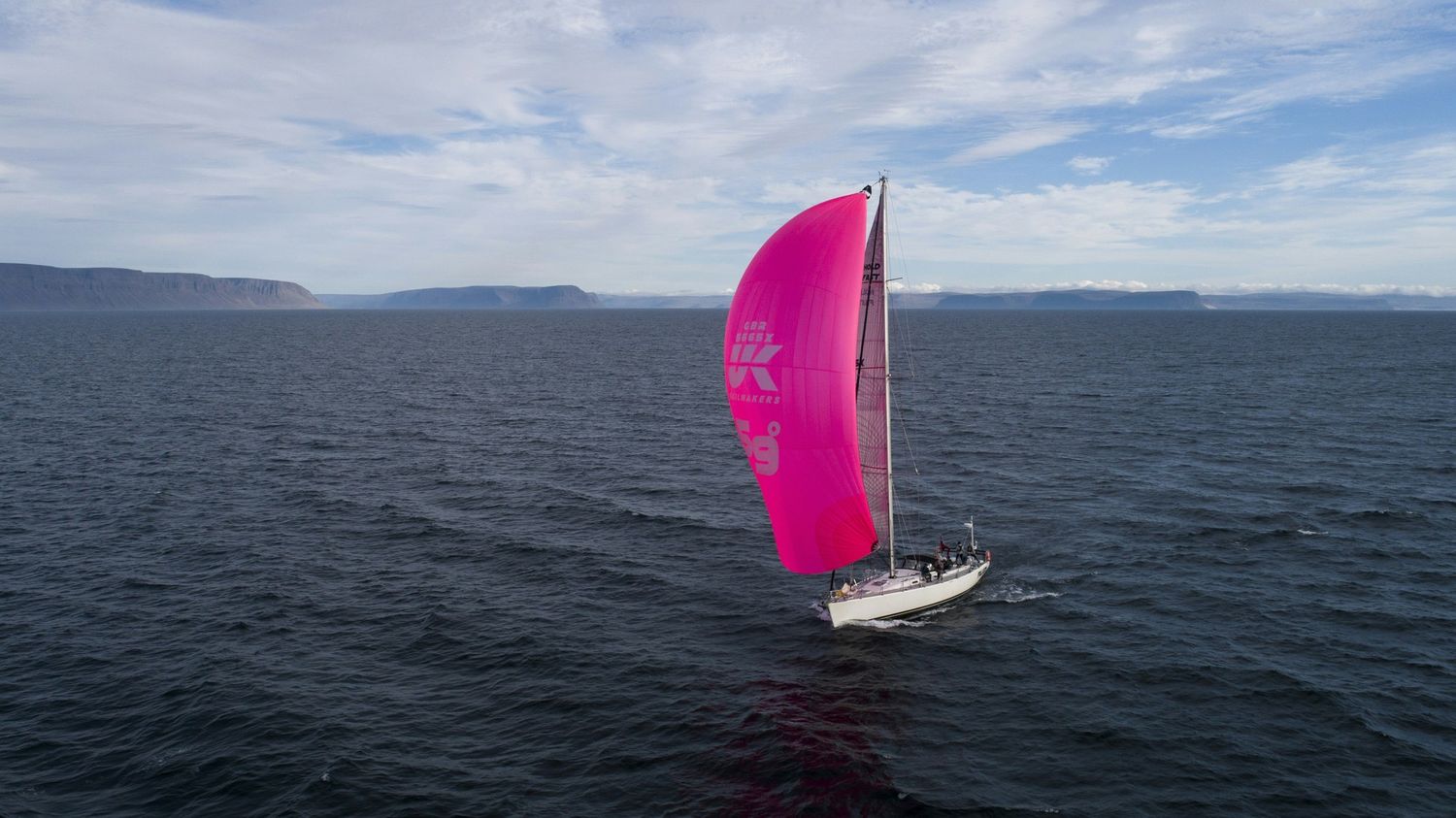
And then, as if on cue, the weather gods gave us our final gift of the passage as a southwesterly sprung up in the afternoon, tempting us to hoist the kite and finish this epic adventure in style. Like that iceberg had coaxed me into the drysuit and into the water, the beautiful 12-knot southwesterly had that little devil on my shoulder saying ‘go on, you call yourself a real sailor, get that chute up!’ This time the angel on the other side agreed, and so it was that FALKEN sailed the last 50-miles into Isafjordjup under her bright pink, 3,200 square-foot S2 spinnaker, making 9-10 knots on an easy flat sea, the crew taking turns steering and admiring the scenery and the skipper reveling in the last 50-miles at sea, the best 50-miles in what was a 3,000+ mile voyage from Annapolis to Iceland.
Annapolis to Iceland. That you can even sail that route hurts my brain a little bit. That you can walk onto the boat in a place as familiar as the Chesapeake Bay, where I grew up sailing, sail for a while (okay a long while), then step off again in a place as exotic as the Westfjords of Iceland…well, that right there is why I go to sea.
—
And then it was all over. Customs greeted us on the dock at 0145 in the morning, completed the arrival formalities with kindness, stamped our passports and that was that. We drank champagne. We ate cheese. We stayed up until 3 or 4 in the morning retelling sea stories, then collapsed into our bunks. Satisfied. We deep-cleaned FALKEN next morning after a short but deep sleep and just like that the crew packed their bags and went on their respective ways. 18 days of intensity ending in the blink of an eye.
Nikki and Emma arrived shortly thereafter and I was officially relieved of skippering duties, happily handing over the keys and able to truly relax for the first time in two months. I’m always kinda shocked at how quickly our boats just move on to the next thing — here we’d just delivered the adventure of a lifetime to 8 strangers-become-friends, who will live on these memories for the rest of their lives (I will anyway), and just three days later FALKEN will be at it again, a new crew onboard, new memories in the making.
And we keep on drivin’ the bus, one stop to the next.
Andy Schell
View more passage logs
El Niño
Nordic Falken and her crew have been on a rollercoaster ride since our departure from Ensenada on Wednesday, hence the lack of blogging! This trip has been dictated by the strong effect of El Niño in the area, making our weather routing tricky but fascinating. Once in the Channel Islands, we had to hide all of Thursday sailing between the California coast and San Clemente island due to a huge pulse of swell on the outer islands. It has been full on learning and we’ve played with emergency steerings, drogues, spinnaker poles, changing headsails, spinnakers, sextants etc.
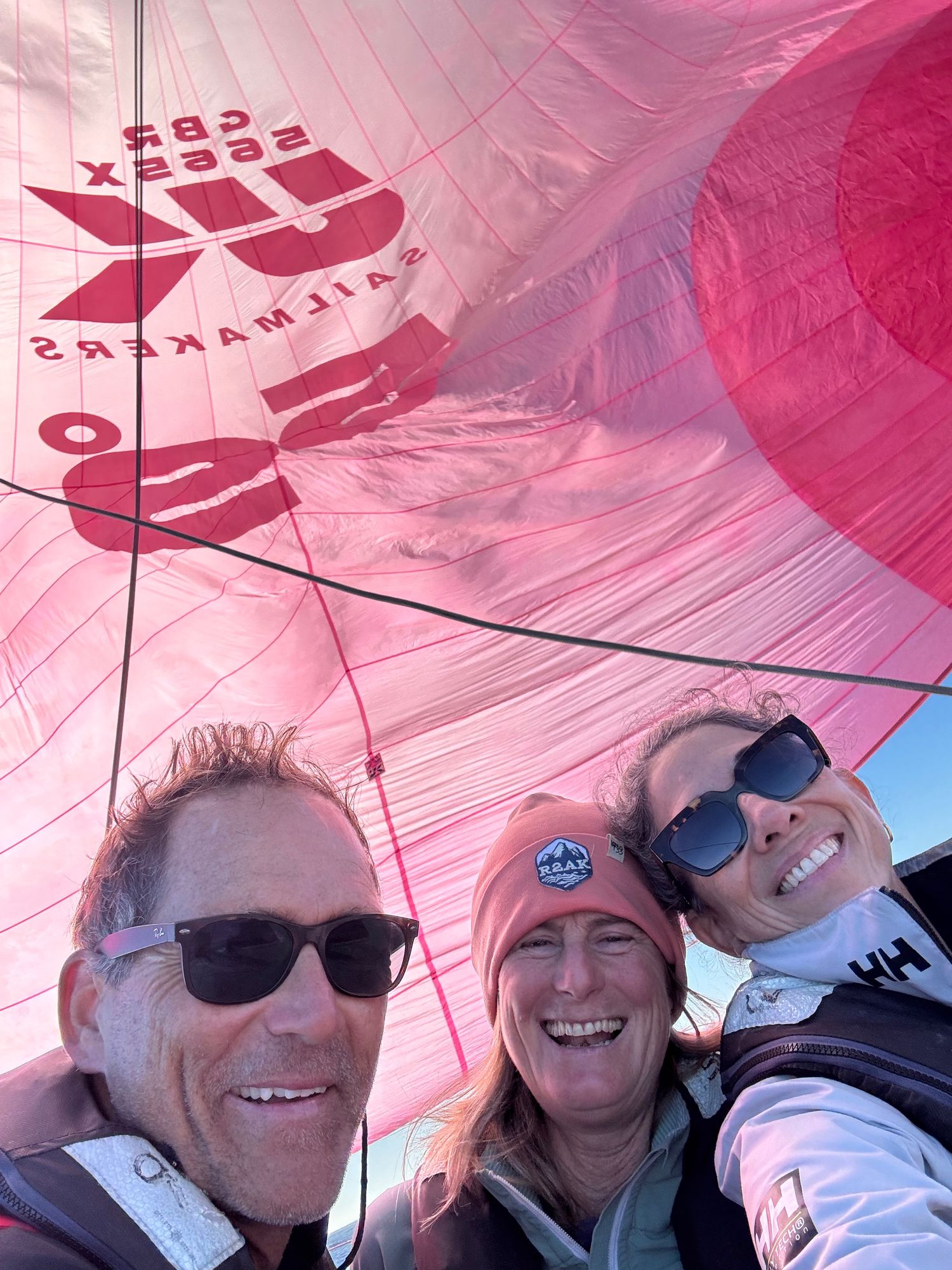
HMS Night Watch Party
Wing on wing worked well until the wind shifted then the helm became the cone of despair for our night watch crew of three (H, M and S) Alex made the decision to drop the pole, shifting wing on wing to a close reach. Wind increased to low teens and speed picked up to a flying pace. Day spent wandering toward Ensenada. Alex, Adam and David got us into port under another starry night.

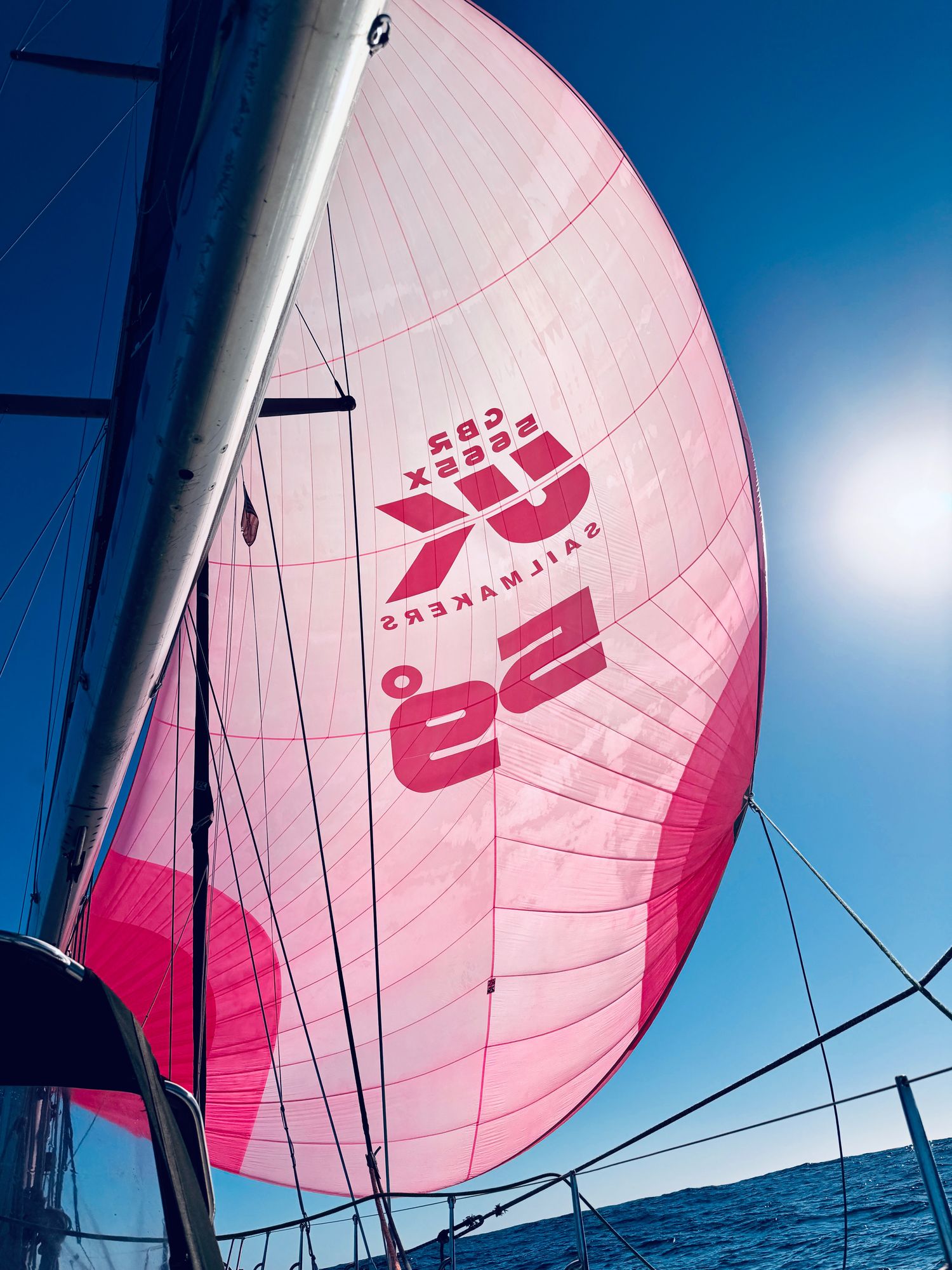
No Kitemares Today
After a night marked by sudden wind accelerations peeling off Point Conception, and a vibrant, pulsating sky blistered with shooting stars, the off-watch woke to commotion on the foredeck. The wind had gone light and the swell had tapered just enough to raise the spinnaker. The sail filled with an urgent pop, the sheet strained and Falken charged down the face of the next wave. By mid-day, we doused the spinnaker and set our minds to the more precise task of safely punching through a gap in the notorious Cortez Bank. The border to Mexico looms ahead.