2200/ 11° 14.77'N, 26°56.87'W
Sailing
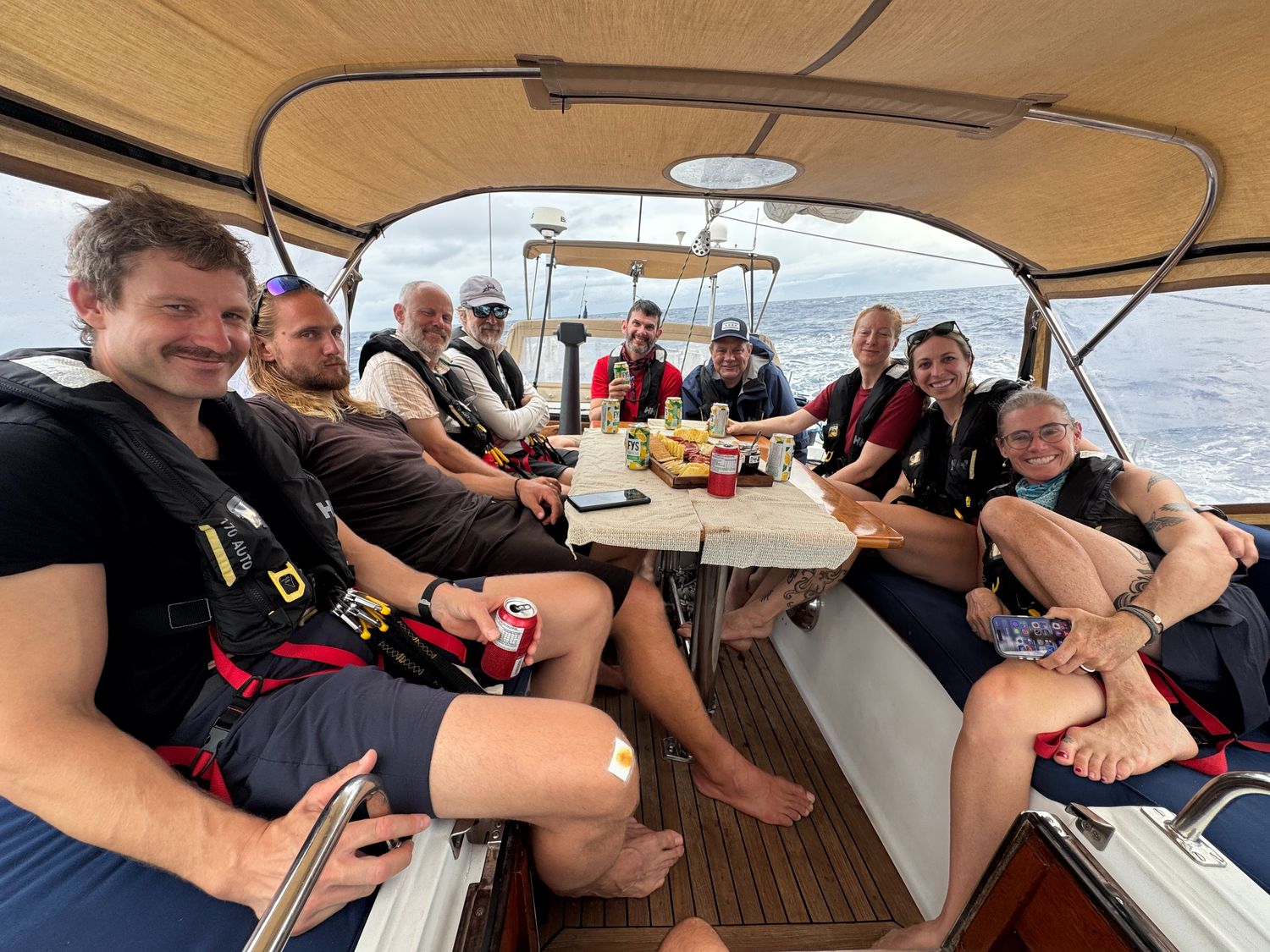
Some of our friends and family are probably wondering what we do all day out here. A few of the blogs have touched on some cool aspects of our experience and feelings both large and small.
Today I want to just share a little bit about something very specific - helming - which is the number one thing that we each do everyday.
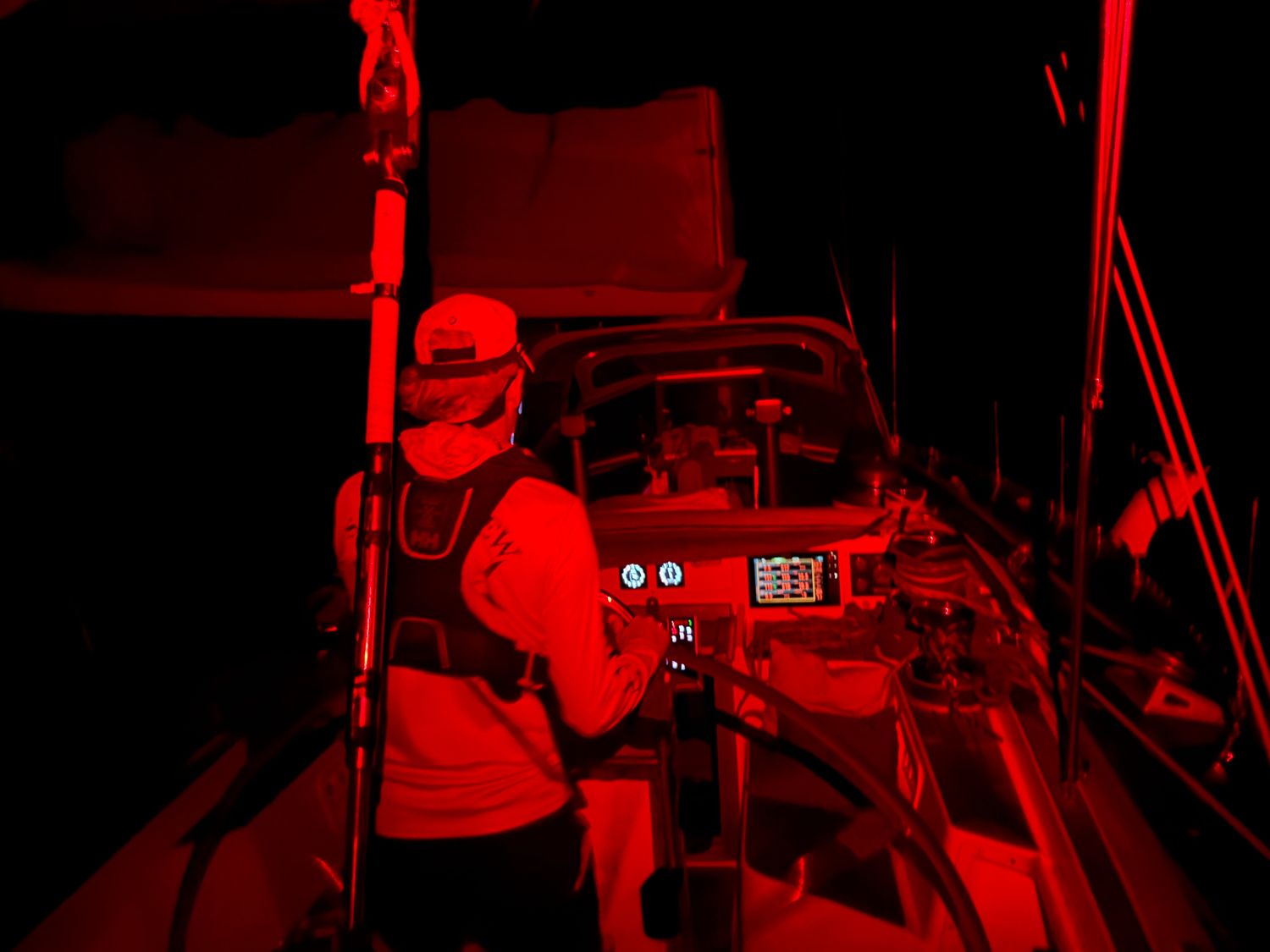
Helming is basically steering the boat by hand. Each of us do this for 3 to 5 hours a day in half hour increments with our watch teams all day and through the night (except for our groups dinners, but that’s a wonderful topic for another day)
You might have seen some pictures of Adrienne’s cockpit and steering wheel. This thing is huge. It’s probably 6 feet in diameter. About a third of it is below the deck we stand on. Just in front of the wheel is a magnetic compass and forward of that are a bunch of instrument that tell us some conditions.
From the moment you step up and take the wheel you’ve got a bunch of tools to guide your hands which turn the wheel which turns our rudder which then guides Adrienne (and us) through the ocean.
These tools are both the instruments - the wheel position, the position and movement of the compass, the readouts of wind angle and strength - they are also the larger environment we can perceive - the sky, the sails, the sound of the water, the angle of the boat, the vibrations in our hands.
Helming is so completely unlike driving anything else. If a big wave hits the boat, or the wind gusts, the whole boat shifts and the wheel spins hard. You have to hold fast or even lean into turning the other way. At other times in steady weather you have to work hard to not steer too much.
How each of us put all this information and sensation together to guide our hands and keep Adrienne going where we want to go - to stay the course as the saying goes - is as different as the individuals on this boat.
Over the 11 days that we’ve been out here we’ve had lots of conversations about what we’re doing, how we’re doing it, and how it feels. As I work out my own approach and learn about others I thought it would be nice to gather what I was hearing and now to share a bit of it with you all. Enjoy.
Peter
I think about force vectors. On the boat when I helm, the acceleration, the turning, everything. it’s just nature working its forces on the boat and I can almost see the force vectors as a helmsman. You don’t actually see them of course, there are so many forces working at different angles on different levels. It’s constantly moving the boat in different directions. That’s what I feel when I’m helming.
Chris
I have been focusing on how the boat feels. Not trying to react to the compass or the instruments but react to the way the boat is handling and the way the waves are and just trying to anticipate things. The boat is telling you what she needs to do. I find that if you’re trying to just look at the compass and I do worse. But if you step back you can do much better. It’s a lot of tactile and visual elements. It is in your feet, it’s in your hands. It’s the feedback from the wheel, how the boat feels underneath you, the waves that come up and down and can push you too far. If you put all your senses together they’ll tell you what to do.
Katy
We’ve been talking about how Adrienne feels like a different dog, weather, wind direction, etc. dependent - sometimes she’s docile, well trained and stays close to her heading with gentle reminders. Other moments…she wants to run, play and pull. If she’s acting like a puppy-dog, like our pug Poncho Villa, you must be mindful about keeping her heading “on track”. Whereas when she’s acting like a well trained labradoodle, you can get her back quickly because she easily comes back where I tell her. And, sometimes she’s more like a Burmese mountain dog - they’re giant but they’re gentle. If they pull, it’s pretty strong but quickly responds and she comes right back around.
I would add that helming this boat can be very overwhelming. It’s just 30 minutes at the wheel, but I’ve got lives and a giant boat in my hands. I would say the first two or three times, especially helming at night, I was like “oh fuck”. This can be scary shit. I try very hard not to think about, to overthink the weight of it all. Conversely there are more and more moments when I’m locked in and the boat is moving along without that sense of weight. In fact, it feels like freedom…I’m the tail on the back of a kite. Then, I feel like a rockstar.
Katelynn
My first time helming was on my last trip with 59 north across the north sea. I had absolutely no idea what I was doing, so for me, it was just trying to counterbalance all the forces on the rudder while helming. This time around, I’m very fortunate that the sea state has been a little calmer so i can focus on other factors while helming. Now i believe the helm is using all of your senses. Having the sails trimmed, finding your course, and getting a sense for how it feels from your feet to the sky. Helming to the stars is magical. Getting a feel for how the pressure in your feet feels and changes with each wave. I also look at taking the helm of a boat similar to getting to know a person. It requires a lot of patience… learn what she does or doesn’t like.
The other day when we turned off all the instruments, that was my absolute favorite because I was purely relying on the wind and my senses. That is the most magical feeling. It just felt so good because once you get a feel for what that shift is like you learn to trust yourself and the relationship you’ve created with the helm.
Tonya
Helming for me in most cases is a playful, respectful interaction with the boat. Like so many other activities on the boat, helming shouldn’t be forced. If my helming does get forceful it challenges me to reason why: is it the sea state, the trim or balance of the sails, is there a more optimal bearing, etc. I’m not always able to maintain this, but I feel like I’m getting into the swing of it more and more. I consider visual inputs such as oncoming waves, luffing sails, dropping clues, and tell tails. I enjoy feeling the direction of the wind on my face and hair. This can be difficult on this boat because of the bimini and I’m constantly wearing a hat.
James
I’m usually given a compass bearing to steer by so I will move the wheel slightly left and right and get the feel of where I need to be. I feel the boat to see how much it’s reacting and steer as little as possible in order to keep her on the bearing. That works fine until waves come along, and push the stern to one side or the other at which point you have to drive the helm down and hold it until the wave passes. I listen to the rush of the water going by because as it pushes harder, there will be more gurgling spray, you feel the rudder push against the water. Through hands on the wheel you’re feeling the boat respond. I’m seeing the response of the compass needle and if it continues going one way you have to push down even harder. When the wind picks up the response of the boat is delayed a bit more so I think it’s just an order of magnitude. It increases the response you have to provide in order to keep the boat straight.
Well there you have it helming as described by six people who approach the same basic task with highly varied perceptions, feelings, and even emotions. I think that’s pretty cool. Hope you do as well.
KIF SCHEUER
View more passage logs
The Wheel Keeps on Turning
Helming is basically steering the boat by hand. Helming is so completely unlike driving anything else. How each of us put all this information and sensation together to guide our hands and keep Adrienne going where we want to go - to stay the course as the saying goes - is as different as the individuals on this boat. Well there you have it helming as described by six people who approach the same basic task with highly varied perceptions, feelings, and even emotions.

Navigating with the stars
Once the bimini was folded up the view across the starlit dome above our heads had us in awe and got our full attention. I am writing this during the same watch as I aim to share the beauty of the ocean and special moments we are witnessing during our voyage. Tonight, that light (coming from within and outside our galaxy) is guiding us across this vast open space towards our destination. Witnessing and sharing constellations builds a link to ancient cultures and seafarers, and this view into a world of lightyears and galaxies challenges the day to day notions of space and time you so recently left behind. Thank you for joining us as we sail under the stars.
Equator Day!
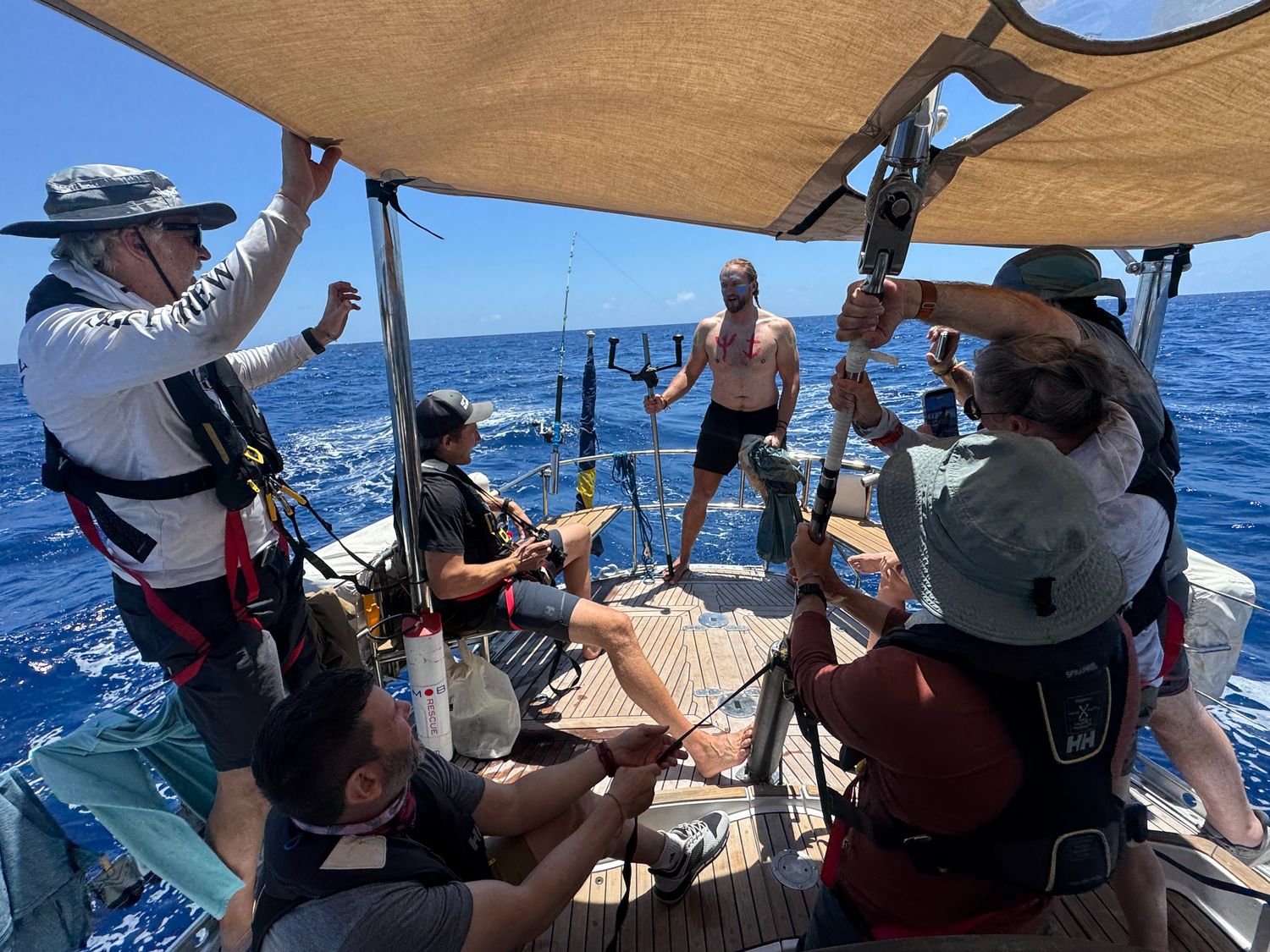
Excitement was in the air as the day dawned, the Equator grew ever closer. Those who go to sea often hear of King Neptune arriving at such a time in order to promote those worthy souls from Pollywog to Shellback, in the watery realm. We were still surprised when he arrived and called upon us to honour tradition and answer for crossing the equator without permission. For me this was one of the features of the trip and it did not disappoint. This is definitely a passage to remember.