2027-10 | FALKEN | ARC Europe: Azores Cruise
The Azores are one of our all-time favorite destinations in the Atlantic, and the islands offer unparalleled scenery and culture. Here's a chance to do something different with 59º North, island-hopping our way from Horta to Sao Miguel and exploring these wonderful islands. Climb to the summit of the 7,700' high Pico, watch the running of the bulls in Terceira and explore the big city in Sao Miguel. Special pricing for crews who want to add-on this passage either after arrival in Horta, or before joining the next leg to Scotland.
The Passage
Rough itinerary
All 59º North passages are very much subject to weather. We pick our routes based on the "correct" time of year to be sailing in the different regions we visit, and we always build-in enough time to give us some margin for weather windows. The skipper has final say on departure dates and weather windows, but generally speaking, the intinerary for this passage will look like this:
June 4, 2027
Crew arrive to FALKEN at 1300 in Horta, Azores. FALKEN orientation followed by crew dinner. All crew stay onboard FALKEN.
Prep Days
Between the joining and departure dates, all pre-passage preparation, provisioning, and safety briefings will be completed. The specific pre-departure schedule will be outlined and posted onboard FALKEN by the skipper.
June 6, 2027
Scheduled departure, weather dependent.
June 8, 2027
Latest date (12:00 noon) for crew to depart FALKEN from Sao Miguel, Azores.
TRAVEL LOGISTICS
Horta
Horta has been the finish line for five of our recorded passages, an Atlantic waypoint 59º North has come to know well between 2017 and 2024. Isbjørn made landfall here after crossing from Bermuda in 2017 and again in 2021, Icebear arrived in both 2021 and 2022, and Falken completed the run from Bermuda in 2024—a testament to Horta's enduring place on the transatlantic sailing map.
Set on the island of Faial in the central Azores, Horta is one of the great crossroads of the sailing world, a mid-ocean haven where boats bound between the Americas, Europe, and the Caribbean converge. Its marina is famous for the thousands of painted panels left by visiting crews along the harbor walls and breakwater, a tradition said to bring good luck to those who add their own. Volcanic landscapes rise behind the town, and across the narrow channel the perfect cone of Pico volcano dominates the eastern horizon. Peter Café Sport, the legendary sailors' bar overlooking the waterfront, has welcomed ocean voyagers for generations and houses a small scrimshaw museum upstairs.
With a day or two ashore, crews can climb to the rim of the Caldeira do Faial, walk the ashen expanse of the Capelinhos volcano that erupted in the 1950s, or wander Horta's cobbled streets and blue-and-white azulejo façades. Whale-watching and coastal walks offer a fine reintroduction to solid ground after weeks at sea.
Airport Info
Horta Airport (HOR) is located on Faial Island, with regular flights from Ponta Delgada Airport (PDL) on São Miguel Island, and seasonal flights from Lisbon.
Sao Miguel
São Miguel is the largest and most populous of the nine volcanic islands that make up the Portuguese archipelago of the Azores, adrift in the mid-Atlantic and long nicknamed the "Green Island" for its vivid, rain-fed slopes. For centuries these islands served as a crossroads for ships crossing between Europe, the Americas, and Africa, and Ponta Delgada, the island's capital on the south coast, grew into the Azores' principal port. Its long protective breakwater shelters a marina that has become a familiar refuge for ocean-crossing sailors, marking the first landfall for many boats after weeks at sea.
The island was shaped by six volcanic zones, and that fiery origin defines everything a visiting crew will find ashore. Ponta Delgada's waterfront is fronted by the whitewashed city gates and cobbled streets of a historic port town, an easy walk from the marina. With a day or two to spare, sailors can climb to the twin crater lakes of Sete Cidades, ringed by towering cliffs, or cross to Furnas, where hot springs bubble from the ground and cozido stew is slow-cooked in the volcanic earth.
Along the coast lie further points of interest, including the small islet and offshore anchorage near Vila Franca do Campo, a flooded volcanic crater open to the sea. Between the geothermal valleys, dramatic calderas, and the working rhythm of an Atlantic port, São Miguel offers an unforgettable threshold to or from a long ocean passage.
Airport Info
João Paulo II Airport (PDL) is the main airport on São Miguel Island, with flights from mainland Portugal and other European cities.
Weather conditions
Expect a generally mild, pleasant passage with the typical Azores mix of settled spells and the odd breezy patch—lively enough to keep you sailing, but nothing the boat can't handle as you reach across to São Miguel.
In-depth analysis, by WRI
The East Atlantic in June often sees a dominating high generally in latitudes near 35-37N, with a ridge over the tropical and subtropical Atlantic from 45N and S'ward. The gale track tends to stay farther north from E'rn Canada towards Iceland, with fronts extending to 33-35N but tend to weaken around 60-65W as they encounter the high. Tropics tend be rather low in June across the open Atlantic (tropical waves tend to remain along/south of 15N), with the W'rn Caribbean mainly being the hotspot region during this time. Winds largely prevail from the W-SW typically at/less than 20kts, and seas generally range near 1-2mtrs (3-6ft) but has a likelihood of building to 3mtrs (10ft) across June, prevailing from the W-NW and sometimes from the S-SW over the broad Azores region. Occasionally, winds will be from the NW-N-NE direction behind frontal passages.

WHY 59º NORTH?
ambitious sailing schedule
We sail upwards of 20,000 miles per year in all oceans of the world, and in over 200 passages, we've only been late by one day, one time! We've been able to accomplish this by properly planning our trips with enough time for weather windows, and allowing a few days in port between trips for staff to recover, re-provision and complete routine maintenance (most charter companies allow only a single day turnaround, which is insane!).
Every 4-5 trips we build in a 'fuse', where we have a 2-3 week maintenance period allowing us to take care of the boats in normal circumstances, or give a buffer should we get delayed by unforeseen circumstances prior to this break.
The best boats
We take pride in the maintenance of all of our boats, and hold ourselves to extremely high standards. We buy sails that will last for tens of thousands of miles, while holding their shape (unlike standard dacron); we carry lithium battery banks with high-output alternators so there's less time running the engine to charge at sea and killing the vibe; we carry enough sails to sail the boat to the conditons, whether that's heavy weather or light weather, to give you the full experience.
WOMEN BUNKS GUARANTEED
As a woman sailor, you will never be alone on a 59º North passage. We guarantee at least two women on every passage, and save those bunks before they sell out. If they don't sell, they're given away to women apprentices - yes, we put our money where our mouth is.
In fact, we rarely ever have to. 59º North passages have always been 'mixed' - not only by gender, but also by age, nationality, background, you name it. Back around 2022, we had a few prospective crew wondering if they'd be the only woman onboard. As that had almost never been the case, we decided there and then to guarantee it.
Our staff are also mixed gender as often as is logistically possible, and several times per year, on both boats, we run All-Women's passages, staffed and crewed entirely by female sailors to help further empower an often overlooked demographic at sea.
Professional, well-paid staff
Adventure sailing is the highest calling for most aspiring skippers who truly want to sail. Unlike superyachts, who spend most of their time in port, we spend most of our time at sea, and the real sailors who want to work in that envrionment are attracted to it.
Sadly, the industry-standard pay is extremely low, and offers little in the way of a safety net, or provisions for having family back home. We want to change that.
All of our professional staff are paid well above industry rates, and we sail on rotations of usually 6-week stints, so those of us with families and small kids ashore can be present as parents and partners while still living our dreams.
The truth is, most of us would do this job for free, and that's part of the "supply & demand" that sets the salary rates in our industry.
But at 59º North we value people above all else, and that starts with our staff, many of whom have been with us for years and will be familiar faces to those who return to sail with us again and again.
knowledge & community
When you sign-on to sail with us, your journey to ocean sailing starts the minute you click "Submit" on your signup form when we start the preparation process with you to go to sea. That includes:
- Extended FREE trial in our Quarterdeck seam'nship community & knowledge-base.
- Series of 3 newsletters leading up to your passage, including specific packing lists, gear discounts with our partners (including 25% off everything at Helly Hansen).
- 1-1 comms with Andy, Mia & August and our skippers if you have any questions before your trip.
Once you join the boat, you'll see why people sail with us again and again. But your experience doesn't end when the passage is over. You'll get:
- Exclusive earned patches for different milestones you've earned with us at sea.
- Sea-service letter/signed logbook if you're looking to earn miles towards a license.
- A final newseletter with photos and other useful information, including a copy of the handwritten logbook you kept while on the boat.
Why it costs what it costs...
Imagine you’re craving a burger.
On the same street, there are two restaurants. Both serve burgers. One is mass-produced to be fast & cheap. The other is made with carefully sourced ingredients by people who genuinely care about making a great burger (even great veggie burgers!). The bun is baked that morning. The onions are pickled in-house. The beef comes from a local farm. Every little detail is curated & intentional.
On paper, both have pretty much the same ingredients: a bun, a patty, cheese, onions, pickles and some sauce. They’re both burgers.
But nobody would argue that they taste the same or provide the same experience.
Offshore sailing is, weirdly, similar. You get out what you put in, and we put in a lot of effort to cross oceans in safety, in style, on-time and with passion.
At 59º North we obsess over and invest in the details: experienced career skippers, beautifully maintained boats & meticulous preparation, small crews, "teachable moments" and a culture of camaraderie.
Those choices cost more.
We know they’re worth it.
The end result of our "burger" is that it'll be the best-tasting burger you've ever had, literally life changing. Yes, you'll cross oceans, but the overall experience is what you'll remember for years to come, and what you'll want to return again and again for.
That's one tasty burger.
Hold Fast,
Andy | Skipper & Co-Founder
THE BOAT


Farr 65
'
FALKEN
'
🇬🇧
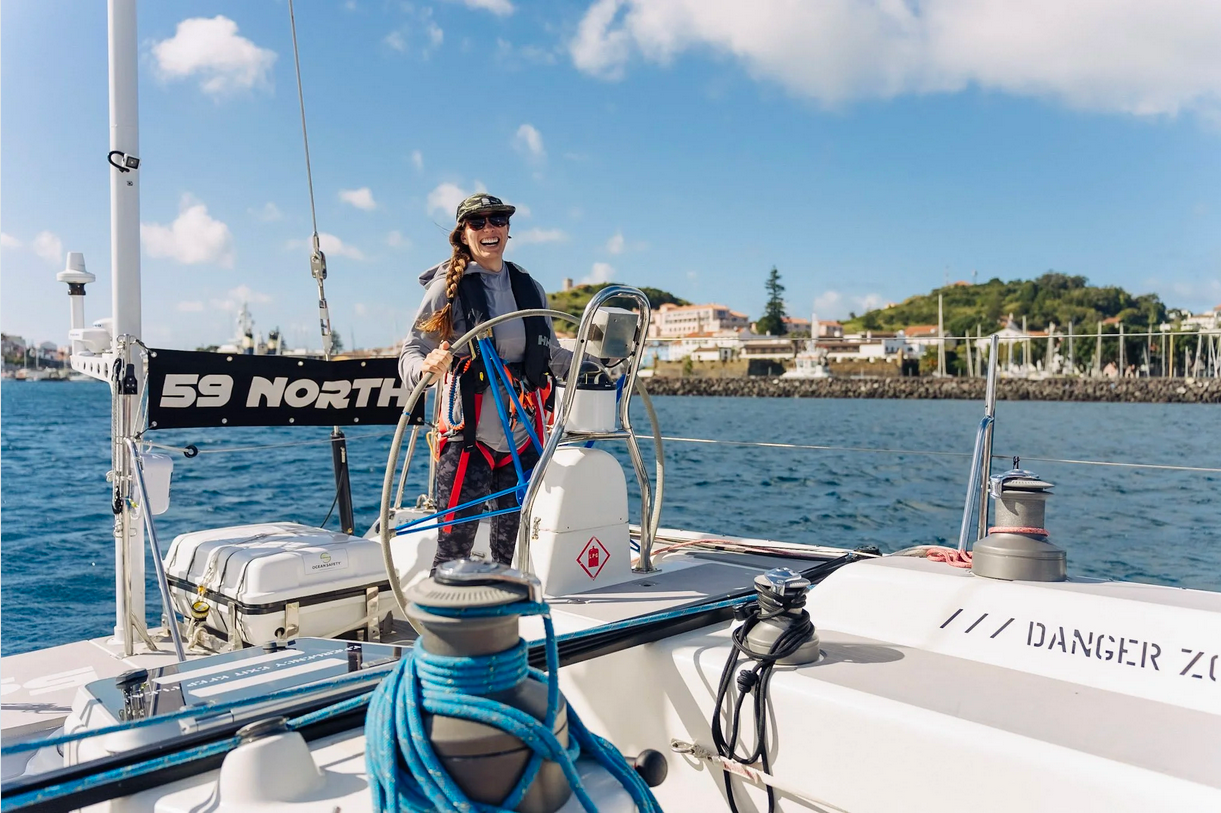
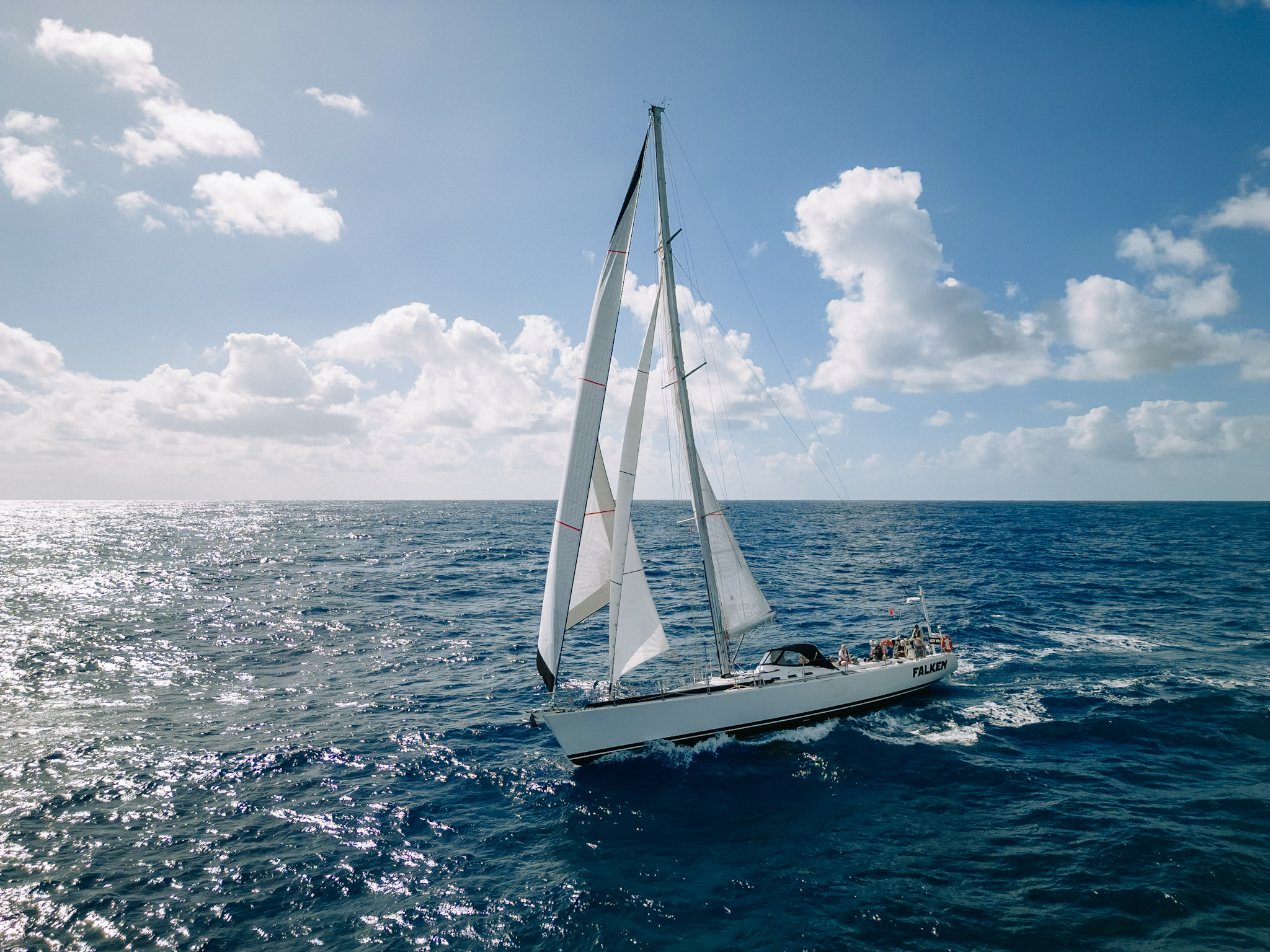
FALKEN is ideally set up for long-distance offshore sailing. We fully rebuilt the boat in 2022 to our exacting specifications and with the help of legendary yacht designer Bob Perry. She's comfortable belowdecks and each crew has their own dedicated sea berth & gear locker. On deck she has a huge cockpit which easily seats 10 people for our daily meals offshore, and allows for plenty of room to move about when handling lines and trimming sails. She's also easy to maintain, fast and fun to sail! FALKEN sails with 8 crew plus a Skipper & Mate and the occasional apprentice.

packing lists & notes
Packing Notes
Start here when planning your packing for sailing with 59º North. This list includes the general basics for all of our passages. The passage-specific packing lists offer more details.
Cold | Warm Packing List
This will be a "transitional" passage, either starting in warmer climes and increasing in latitude until it's significantly cooler, or vice versa. Another one of those trips where you'll need to pack one of everything for changing conditions. See the packing list for specifics.
FAQS
What’s included in the crew fee?
The crew fee for the passage includes everything you need on the boat, plus use of the following:
- Helly Hansen 'Inflatable' PFD with integrated harness to use while aboard.
- Spinlock Double-tether for moving around on deck to use while aboard.
- All meals, snacks and drinks while on the boat.
- Sheets, quick-dry towel & a pillow.
- Large collection of books onboard, including novels, sailing classics and sailing reference books, in hard copy.
What the price DOESN'T include:
- Transportation to and from the boat.
- Meals and drinks ashore.
- Personal toiletries & clothing.
- Foul-weather gear (see packing list for details).
What happens after I signup to sail with 59º North?
After you submit your initial signup form, we'll send you a link to a longer application that will ask all sorts of questions about your history and why you want to go ocean sailing. The more detail you can provide, the better.
Once your application is approved, and provided we have space available on your chosen passage, you'll receive an invoice for 50% of the total crew fee. Once this invoice is paid, your crew space will be fully confirmed. We'll hold the space in the interim between application approval and invoice payment.
Next, you'll get a series of newsletters from us with increasingly specific details about your chosen passage as we lead up to departure date. Three newsletters in total will be sent prior to you joining the boat, and will include things like packing list advice, travel insurance recommendations, introductions to your shipmates and sailing staff and more. You'll also receive another link to fill-out even more information we need from you like medical forms, food preferences and visa information.
Once you've completed the passage, we'll send a 4th and final newsletter wrapping up your trip, which will include links to submit photos to share with the crew, a PDF scan of the handwritten logbook we kept during the trip and a request for a testimonial from the crew!
What can I expect to learn on a 59º North trip? Do I get a certificate?
59º North is not a sailing school, and we don’t issue any official certificates (but will gladly sign your logbook), but crew often say they have learned more in one day with us than a full week of formal class. That’s because we teach the real thing, with real stakes, having to get the boat from one port to another in varied weather and on a timeline.
Focusing on fundamental seamanship, we’ll teach you how to anticipate the weather & make routing decisions, how to optimize the sail plan for different points of sail in different conditions, how to helm, how to use the radar and on and on. You will become a better sailor — and a better thinker — sailing with 59º North.
We’ve created an environment onboard that fosters hands-on learning and teamwork. Our skippers and mates are almost always co-ed, and we sail with a diverse crew of mixed genders, nationalities, ages, sailing & life experiences. Everyone gets an equal opportunity to participate in running all aspects of the boat, from navigation, helming, sail trim etc., and yet nothing onboard happens by accident. Skippers & mates manage the crew’s varied fitness and skill levels to make sure everyone stays safe while being able to fully participate.
How much experience is required to sign on for a passage?
The short answer? NONE! We have had several crew who have never even set foot on a sailboat before, but they have the dream, and that’s what’s important. Our crew, John M., always dreamed of seeing the ‘stars down to the horizon,’ yet he’d never been sailing. He changed that with us, and has since been as far as South Africa to complete a coastal nav. course and sails regularly on Lake Ontario in his free time. You’ll of course understand more of what’s going on the more experience you have, but it’s not in fact required.
That said, we DO require a certain level of physical fitness to join us offshore. Regardless of how much we emphasize it, most people still underestimate how difficult it is simply to LIVE on the boat offshore, even on a nice day.
How long are the watches?
Our watch schedule is flexible and ultimately up to the skipper. Traditionally, watches were divided into periods of 4 hours, with two different watches standing a 4-on / 4-off schedule, often with a small adjustment at dinnertime, and onboard ISBJØRN we normally follow this type of schedule. On FALKEN, we typically run a two-watch system, standing 6 hours on in the daytime, then 4 hours on at night. On tropical routes, when it’s hot in the daytime, we sometimes flip this to limit sun exposure. Regardless of which watch system we use, crew are always gathered together for dinnertime, allowing us to eat together and reflect on the day.
The skipper and mate stand a different watch schedule than the crew, so that one of them is always awake and supporting the crew. Their schedule allows them to spend time sailing with all the crew.
On an ocean race, where all crew is given specific roles, a ‘watch captain’ would ultimately be in charge of decisions on their watch. However, given the range of experience of the crew, we do not assign watch captains — rather, if there is discussion among the crew as to what to do, then the captain is woken up to settle the debate!
Will I be able to communicate with friends or family during the passage?
Not by default. We have emergency comms onboard and the ability for your family to contact the boat via Mission Control, but if you'd like to be able to connect directly to send/receive text messages, you'd need to bring along your own Garmin InReach or similar device. If you would need to make an emergency call home, we can arrange use of the ship's satellite phone.
Note that we do not, and will not, provide Starlink access to crew for broadband Internet offshore. While FALKEN now has Starlink installed, it's for weather, emails and emergency comms only and not for crew or staff use otherwise. We believe that the limited connectivity during an ocean passage is a feature not a bug. This allows us and the crew to stay in the moment in a way that is impossible ashore, and the experience is that much richer for it.
Do you have Starlink?
We've installed Starlink for the 2026 season aboard FALKEN, but not for the reasons you might think. Mainly it's to allow staff to have broadband internet while in port in between passages. We realized we were spending a fortune on eSIM cards and phone data, so opted for Starlink to use in port.
Offshore, we use it to send blogs from the boat, the occasional social media post and for downloading high-resolution weather forecasts. And of course for emergency comms, particularly for medical emergencies where a Facetime call with a doctor ashore could save someone's life.
Crew & staff do NOT have access to Starlink offshore. It's a feature of our passages to be disconnected when at-sea, and we expect that the crew who sign up to sail with us will enjoy that aspect of the trips.
If you'd like to communicate to friends and family while on the boat, most people in the past have brought along Garmin InReach devices, which allow for two-way text messaging on the Iridium satellite network. These have global coverage and work well, it's "just enough" comms to stay in touch but avoid the doom-scrolling on your phone :)
How do we make travel plans given the uncertain nature of ocean sailing?
Our passages are scheduled based on the average speed of each boat. For example, we use 5.5 kts VMG (that’s ‘velocity made good.’) when planning ISBJØRN’s trips. This is a very conservative estimate for ISBJØRN, as we are usually averaging over 6.5 knots VMG (it's faster for FALKEN, as she's much bigger. In fact, on the About pages for each boat, you can see the historic passage states, including Miles per Day and VMG!) The conservative estimate ensures that we’ll get to our destination with time to spare before the last day of the trip. We still encourage crew not to book return air travel until we know for sure when we’re departing (some passages are easier to predict weather-wise than others, in the Trades in the Caribbean for example). Normally, if you book ahead, booking a ticket out on the final scheduled day of the passage will ensure you make your flight. Crew normally book a few days later and spend some time ashore before they depart.
Celestial Nav: Do you have the tools and books so I can practice offshore?
Both boats are set up with all the books, tools, worksheets and sextants you need to do REAL celestial navigation offshore, and our skippers and mates are trained in the lost art.
On ISBJØRN we have a Tamaya sextant that Andy & Mia bought used at the famous Sailorman chandlery in Ft. Lauderdale for ARCTURUS back in the day and had onboard for their first trans-Atlantic in 2011. It's sailed everywhere that ISBJØRN has for over 70,000 miles, and Andy even has a tattoo of it on his left forearm!
FALKEN also carries a newer Tamaya sextant, given to us by Weems & Plath in Annapolis.
On most passages, we bring out the sextant for a quick celestial primer and if you are extra keen, you are welcome to use the sentant and run sights on your own.