
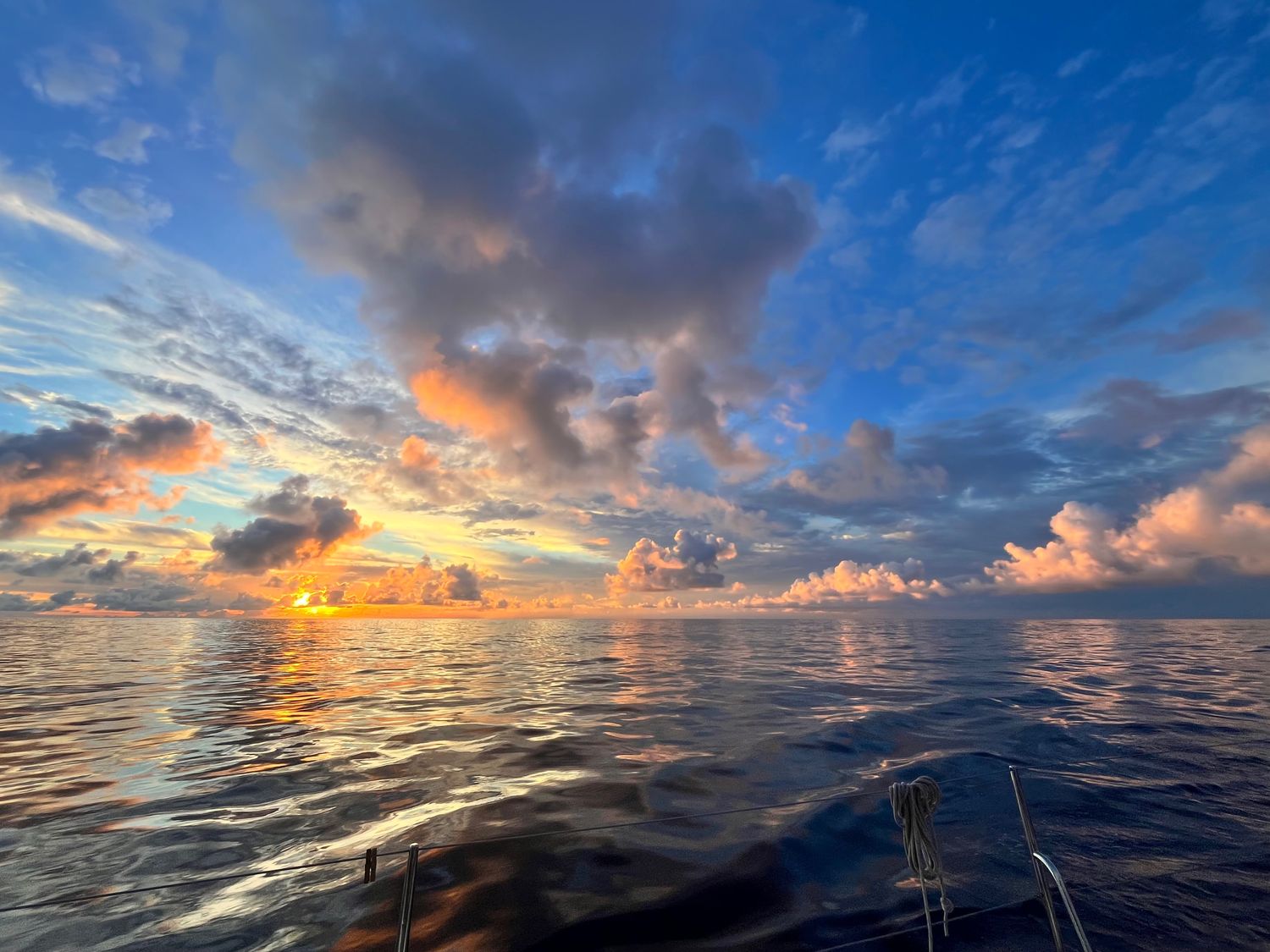
1637UT | 04 29.09’N 148 19.02’W
Sailing/motoring/drifting/reflecting
Land life is predictable, sort of.
Days are marked by routines that you can, more or less, set your watch by. And for added stability, the ground beneath you is stationary.
Boat life is a wee bit different.
Two immediate things stand out.
First, your world is tilted anywhere from 10 - 20 degrees. If sailing were a pinball machine, it’d be game over in the first gust.
And if you’re a gravity skeptic, the concept of Apparent Gravity Angle (ok, I just made that up), may convince you it’s real as you try to brush your teeth or not fall off the toilet when the boat’s cooking at 10 knots on a beam reach.
Second, instead of stationary ground, you’re gliding, bouncing, slamming, pounding, or any of a number of other verbs that describe what it’s like to be on a moving 65-foot machine.on a squishy surface that is chemically always H2O yet never sits still or looks the same twice.
Sounds like fun, right?
I’m not going to kid you. Living on a boat in the middle of the Pacific Ocean is not like taking the car for a spin with the top down and the tunes topped up.
But as humans, I think we’re wired to do hard things.
I dare say it’s one of the things that we should hold tight from technology turning us all into mushy molecules of leisure lovers.
In fact, as I write this in Falken’s hot, steamy saloon 170 miles north of the equator, my crewmate Mark is reading Lin and Larry Pardey’s book, The Self-Sufficient Sailor.
The Pardey’s are famous in sailing circles for spending decades sailing around the world in a relatively small 30-foot(ish) boat with no engine, no refrigeration, no ”modern” head, and none of many other boat life conveniences that many of us deem ”must haves.” Hats off to them because they made it work.
To be clear, despite what my wife might say, I’m not a glutton for punishment. I appreciate modernity and savor a fine Willamette Valley Pinot Noir.
But for me, and I think for many sailors, the desire to ”get back to the basics” is one of the charms of raising the sails and letting the wind blow you to your next destination. The struggle makes the journey and the destination equally sweet.
Although I’ve only been sailing a few years, I’m noticing a pattern when it comes to boat life.
On this trip, I’ve been fortunate (knock on fiberglass), to not get seasick. My adjustment was more about trying to establish routines that I can rely on to give each day a rhythm that eventually will feel like, well, home.
On this 2-week passage, rhythm, at the half-way mark, feels like this.
1. 3 hours on, 6 hours off. We have 3 teams who take turns running the ship. You’re expected to be on deck helming, trimming the sails, and keeping the rest of your crew alive. And for that hard work, you get 6 hours of downtime.
2. Fuel and rest. Preparing food and sleeping are much harder on a boat but you can’t skimp here. When that big blow comes, if you’re not rested, alert, and fueled, then the odds of reading about you in the next day’s maritime news spikes. For me, I had 2 days of transition disorientation as I moved from land to water. By day 3, I was heading back to normal, and by day 4, I was my usual annoying self.
And speaking of that big blow, I was just interrupted writing this as we sailed into a squall and quickly put 2 reefs in the main sail. Not wanting to miss the fun, I put my PFD on, clipped in, and got a refreshing natural shower in the cockpit. It’s so hot here that multiple off-watch crew members did the same.
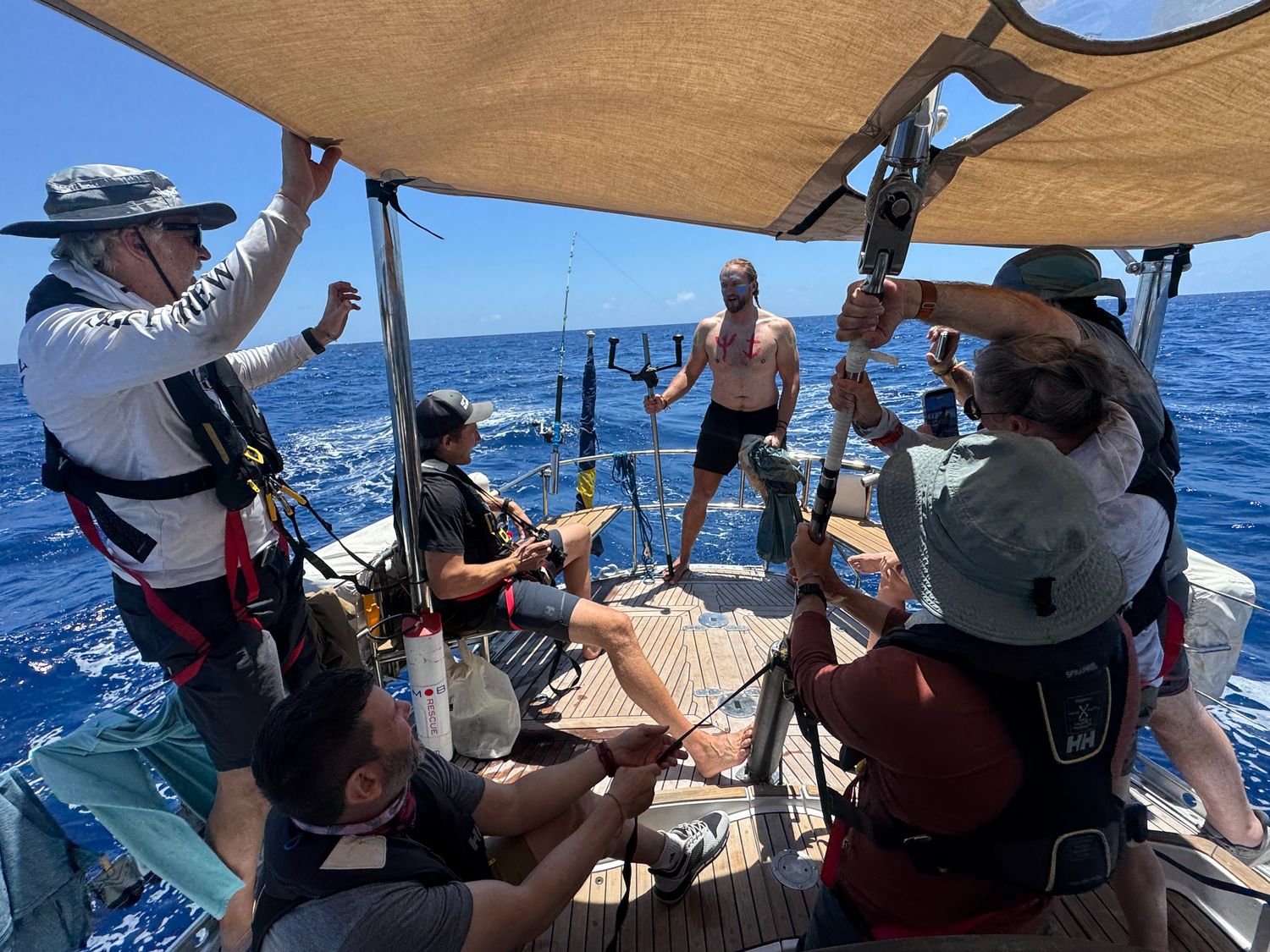
3. Fun and games. We are paying for this so we have to have some fun. This is one area where 59 North excels. The professional crew is selected not just for their sailing excellence, but also for their ability to foster a cohesive, fun, and memorable experience. Our recent visit from Neptune (both of them, ha ha), and the entire Shellback Initiation Experience was epic. If the professional crew were simply drillmasters just going through the motions versus sharing their love for the ocean and fostering camaraderie, then I’m out.
Is making an ocean passage for everyone? Theoretically, yes. But in reality, it takes a certain attitude and a willingness to embrace discomfort (temporarily), a yearning for new experiences and learnings, and an appreciation for this grand, cosmic universe that we inhabit.
On every night watch, I’ve seen multiple meteors, aka, shooting stars. Those brief, bright, intense flickers of flame, light, and heat, are a good reminder to me that our life here is short but it’s meant to be lived like that streak across the sky.
Steve Sanduski
View more passage logs

Navigating with the stars
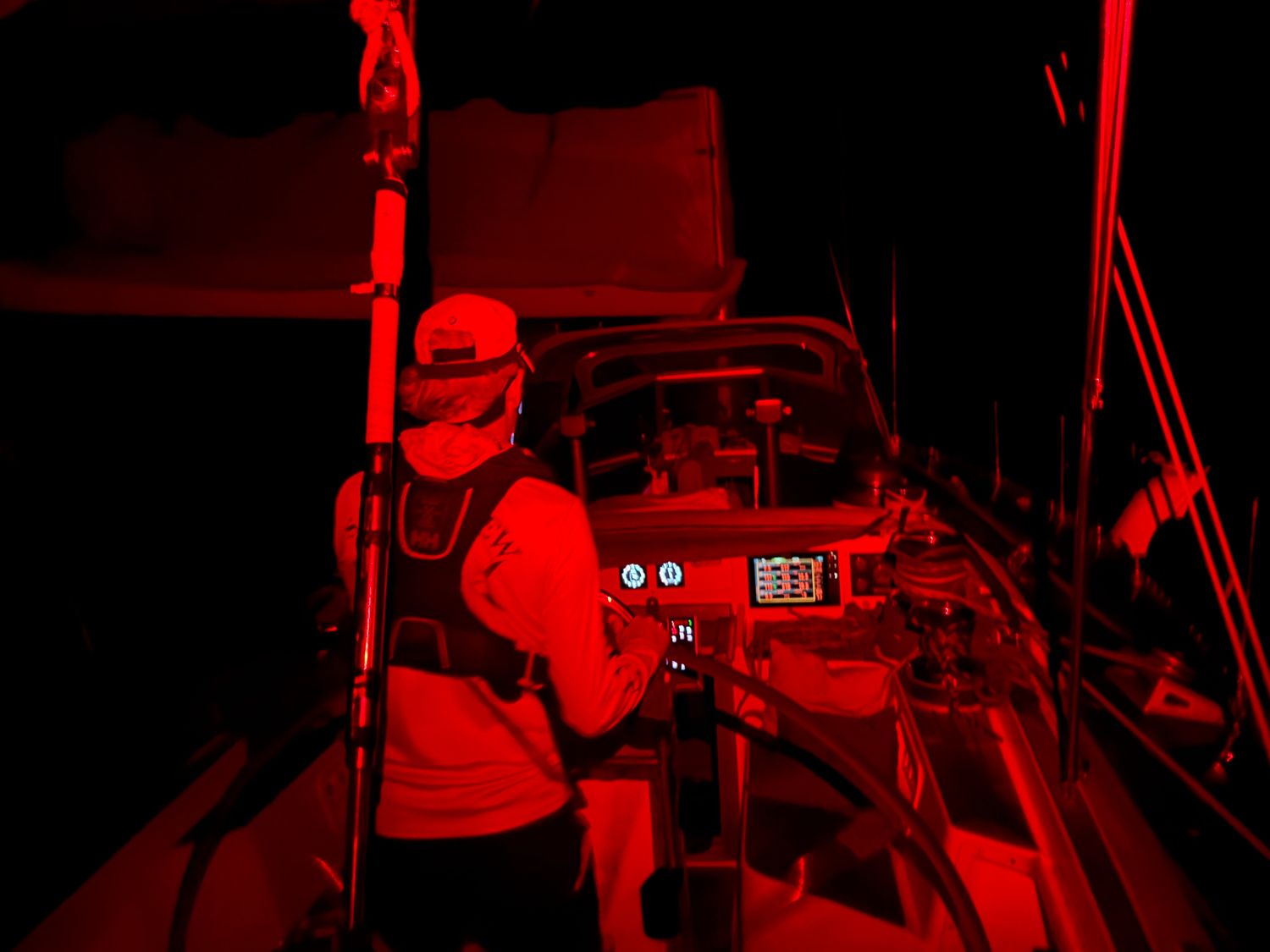
Once the bimini was folded up the view across the starlit dome above our heads had us in awe and got our full attention. I am writing this during the same watch as I aim to share the beauty of the ocean and special moments we are witnessing during our voyage. Tonight, that light (coming from within and outside our galaxy) is guiding us across this vast open space towards our destination. Witnessing and sharing constellations builds a link to ancient cultures and seafarers, and this view into a world of lightyears and galaxies challenges the day to day notions of space and time you so recently left behind. Thank you for joining us as we sail under the stars.

Equator Day!
Excitement was in the air as the day dawned, the Equator grew ever closer. Those who go to sea often hear of King Neptune arriving at such a time in order to promote those worthy souls from Pollywog to Shellback, in the watery realm. We were still surprised when he arrived and called upon us to honour tradition and answer for crossing the equator without permission. For me this was one of the features of the trip and it did not disappoint. This is definitely a passage to remember.
Snag it or sweat it! Rolls Royce bunks, watches and fans
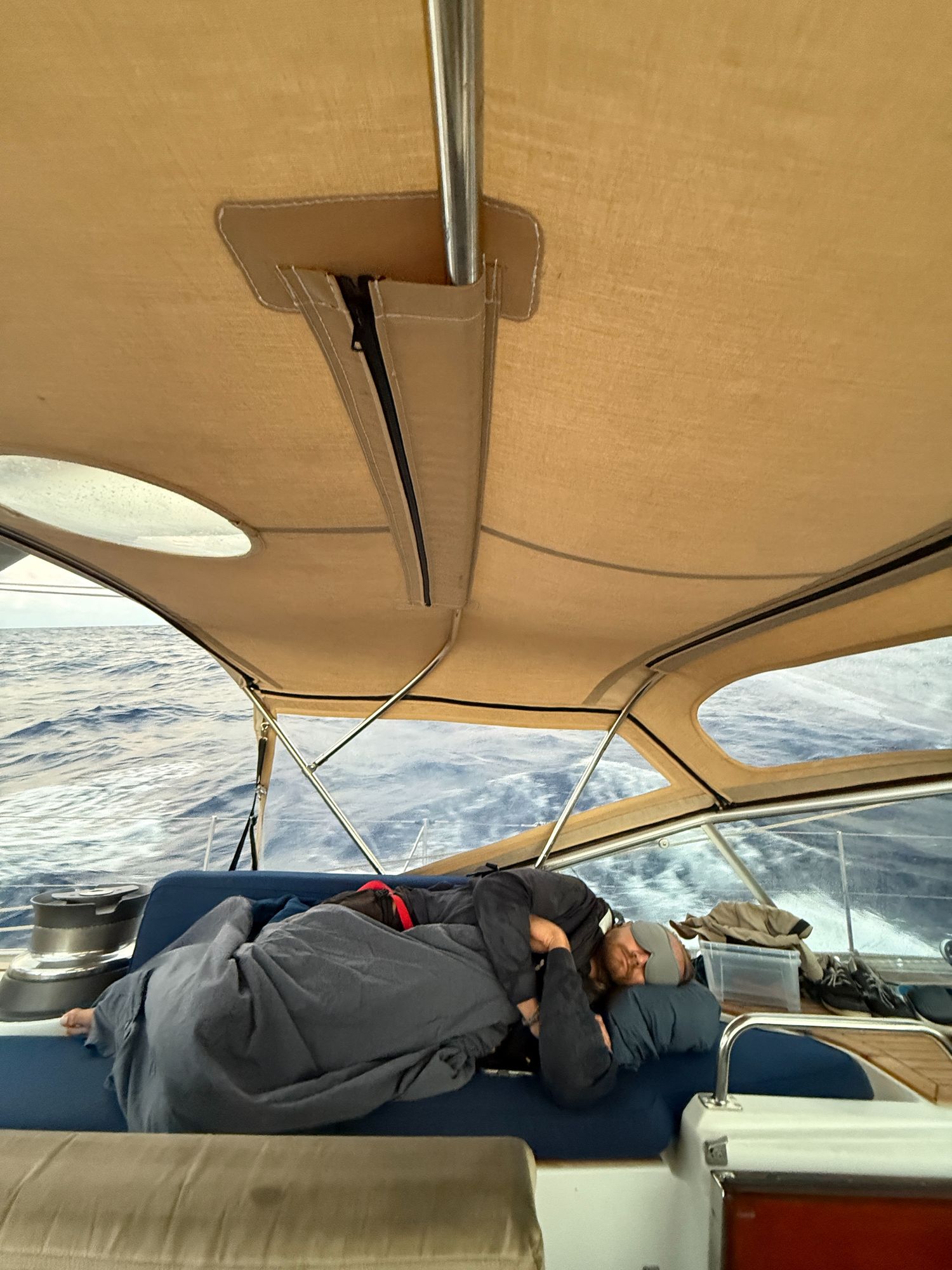
Today marks day 6 of one of the most epic passages I've decided to take on. There is something wildly exciting and equally calming about being surrounded by nothing but ocean. I get to watch the entire rhythm of the world shrink down to wind, weather, watches, and 10 humans trying to get a sailboat to another continent. I'm not sure if former bloggers have noted, but this passage is HOT as balls. We continue to laugh, learn, and sweat.